
Noorani Qaida Learning Levels: From First Letters to Quran Reading


Noorani Qaida learning levels are the progressive skills a beginner develops while learning to recognize Arabic letters, connect them into words, read vowel marks, apply basic pronunciation rules, and prepare to read from the Quran. There is no single universally fixed number of levels: books and teachers divide the lessons differently. A useful learning framework follows six broad stages, with the student moving ahead when the skill is demonstrated rather than after a predetermined number of days.
Parents often ask whether a child is at Level 2 or Level 5, yet two teachers may use those labels differently. One academy might call the entire alphabet its first level, while another separates letter recognition from makharij. Both can teach similar material. The important question is not the label on the report card. It is whether the learner can recognize new examples and pronounce them correctly without relying on memorized page order. This guide provides a practical way to understand progress, monitor learning, and decide when someone is ready for Quran Nazira.
What Are the Main Noorani Qaida Learning Levels?
Think of the levels as a sequence of abilities rather than six mandatory chapters. The order matters because later tasks depend on earlier ones. A learner cannot reliably decode a word with shaddah if they are still guessing which consonant they see. Likewise, reading one familiar page smoothly is not enough evidence of fluency if a new arrangement of the same letters causes confusion.
| Practical level | Primary learning goal | Evidence of readiness to advance |
| 1. Letter foundations | Recognize isolated Arabic letters and hear their sounds | Names and identifies familiar letters in random order |
| 2. Forms and joining | Recognize initial, medial, final, and non-joining patterns | Finds known letters inside unfamiliar short combinations |
| 3. Short vowels | Decode fatha, kasra, and damma with consonants | Reads varied short-vowel combinations without guessing |
| 4. Complex marks | Understand tanween, sukoon, and shaddah | Notices endings, vowelless sounds, and doubled consonants |
| 5. Length and basic recitation | Apply simple madd patterns and introductory Tajweed awareness | Distinguishes short and long sounds in guided examples |
| 6. Guided reading readiness | Combine skills in new words and short passages | Reads unfamiliar practice material with manageable corrections |
This table is an educational framework, not an official universal Noorani Qaida examination standard. Editions differ in their lesson sequence, and a qualified teacher may revisit any stage as needed. Progress can be non-linear: a student may identify vowels well but still need targeted practice with throat letters. Learning levels are most useful when they make those needs visible.
Level 1: Arabic Letter Foundations and Sound Recognition
The first level is more demanding than memorizing a list of letter names. Arabic has 28 basic alphabet letters in the usual counting convention, while some primers display hamza separately. New learners need to distinguish each shape, its dot pattern, and the sound it represents. They also need to recognize letters presented out of order. Reciting the alphabet perfectly from memory does not prove someone can identify an individual letter on a Quran page.
Consider the letters ب, ت, and ث. Their basic outlines are related, but their dots differ. If a student identifies ب only because it is always the second item on a printed line, the visual skill remains weak. Instead, show mixed cards, change the order, and ask for recognition without hints. Then ask the learner to match the symbol to a teacher-modeled sound. Recognition and pronunciation are connected skills, but they must be checked separately.
Early makharij work also belongs here. The lips, tongue, and throat contribute to different Arabic sounds. For example, ب uses both lips, while ت involves the tongue near the upper front teeth. Students should not be expected to solve difficult Arabic articulations from English spelling alone. A Bengali-speaking teacher may explain the position in Bengali while modeling the original Arabic sound. The goal is to learn the Arabic pronunciation, not to replace it with Bengali approximations.
A learner is ready for more complex reading when they can identify letters in random order and respond to correction. Perfect speed is unnecessary. Reliable attention to shape and sound matters more. Teachers may spend additional lessons on similar-looking letters, distinctive throat sounds, or heavy consonants before introducing word construction.
Level 2: Connected Letters and Shape Changes
Once isolated letters become familiar, students meet a new visual challenge: Arabic letters often change appearance according to their position in a word. Some connect on both sides when neighboring letters allow it; others do not connect onward to the next letter. This is not a minor handwriting detail. Connected-letter recognition is essential to decoding ordinary Quranic text.
A useful example is ب, which may appear as ب, بـ, ـبـ, or ـب. The same letter can look different without becoming a new sound. Students should compare these forms side by side and then locate the letter in short combinations. Instructors can move from a two-letter form to longer examples, slowly removing visual clues as the learner becomes more comfortable.
Arabic is read from right to left, and beginners need to follow that direction consistently. They should also learn the familiar non-joining group ا, د, ذ, ر, ز, and و, which do not join to the following letter on their left. A break in written connection does not automatically mean a new word begins. Recognizing that distinction helps prevent students from treating an ordinary Arabic word as separate isolated fragments.
At this level, educators can assess whether the student recognizes letters they know in unfamiliar contexts. A learner who identifies ب in a row of single letters but confuses it inside ـبـ needs more visual practice, not an advanced Tajweed lecture. Simple sorting, highlighting, and matching exercises are often more useful than long reading passages at this stage.
Level 3: Reading Letters With Short Vowels
Short-vowel marks transform letter recognition into syllable reading. Fatha (َ), kasra (ِ), and damma (ُ) tell the reader how a consonant is vocalized. With ب as an example, بَ, بِ, and بُ have distinct short vowel sounds. In many Bengali learning contexts these marks are called jabar, jer, and pesh. Knowing both familiar classroom names and standard Arabic terminology can make future lessons easier.
The central task is to read a marked letter directly, rather than saying the letter’s name and then guessing the vowel. A teacher might show a sequence of mixed forms and vary the marks while keeping the consonant constant. Next, the teacher changes both the consonant and vowel. These small adjustments encourage actual decoding rather than recitation from memory.
A frequent obstacle is turning short vowels into long vowels because the learner imitates familiar Bengali or English sounds. Another is reading an unmarked practice letter as though it has a default vowel. Both issues become clearer when the teacher contrasts short-vowel syllables with later madd examples. The student should hear and produce the distinction before moving into more complex combinations.
Readiness for the next stage can be tested with unfamiliar two- and three-letter sequences made from already learned letters and marks. Accuracy is more important than speed. A student should also be willing to pause and correct a vowel instead of continuing confidently with an incorrect pattern.
Level 4: Tanween, Sukoon, and Shaddah
This level adds marks that affect syllable structure and consonant behavior. Tanween is represented by doubled vowel marks, generally producing a final /n/ element in connected reading, subject to the applicable rules. Sukoon indicates that a consonant has no following short vowel. Shaddah indicates a doubled consonant. Beginners do not need every advanced rule immediately, but they should be able to recognize these written marks and respond appropriately to them.
Sukoon is especially important for learners who habitually insert a short vowel after every consonant. In a short phrase, an extra vowel can change the pronunciation of the word. Practice should involve carefully joining a preceding sound to the sakin consonant, with repeated listening and correction. A visually simple symbol can represent a significant change in how a word is spoken.
Shaddah requires the learner to recognize a consonant held or doubled, rather than treating the mark as decoration. Teachers can contrast a basic marked consonant and the corresponding shaddah pattern using age-appropriate examples. Tanween practice can begin with recognition and continue to the relevant connected-reading and stopping rules. Students should not be taught that every tanween ending sounds identical when stopping.
If a learner understands the terms but routinely misses them while reading, another week of practical decoding may be more valuable than moving to the next printed page. Level four is a skill-building stage: visual detection, listening, correction, and consistent application belong together.
Level 5: Madd, Leen, and Introductory Recitation Rules
At this stage learners discover that Arabic vowel length is meaningful. Under the appropriate conditions, alif, waw, and ya function as madd letters. Some beginners need extra practice distinguishing an ordinary short vowel from a longer sound, especially when they have learned Arabic through a transliteration system that does not show length clearly.
An instructor can introduce the ordinary madd patterns first, model a natural two-count elongation where applicable, and avoid teaching all forms of advanced madd in one sitting. The correct length depends on the specific rule. Leen involves a sakin waw or ya preceded by fatha, and its behavior differs from ordinary long vowels. These distinctions can be introduced through listening and short examples rather than abstract terminology alone.
Other common introductory concepts may include qalqalah and ghunnah. Qalqalah applies to particular consonants when sakin; it is not an extra vowel to insert after them. Ghunnah is a nasal characteristic used in specified recitation contexts, not a way to nasalize every sound. These ideas deserve careful pronunciation modeling because a student reading explanations independently may misinterpret them.
The aim of Level 5 is not Tajweed mastery. It is to establish enough rule awareness for guided reading. More comprehensive pronunciation, sifaat, and recitation lessons can continue in an advanced course after foundational letter and symbol recognition becomes stable.
Level 6: Integrated Reading and Quran Nazira Readiness
The final level brings previously separate skills into a meaningful reading task. A teacher presents a new line containing known letters, vowels, joining patterns, and selected marks. The learner reads it aloud, pauses to think, and receives correction. The teacher then changes the example. This tests transfer: can the student use the rules beyond a memorized Qaida page?
One student may read slowly but accurately, needing only occasional reminders. Another may read quickly while repeatedly missing short vowels or changing similar consonants. The second student may need more foundational practice despite appearing fluent. A responsible assessment considers pronunciation accuracy, decoding, self-correction, attention to vowel length, and response to feedback—not the number of pages completed.
Teachers may introduce short Quranic reading selections when the student is ready, but completing Noorani Qaida does not guarantee that every learner can immediately read the entire Mushaf independently. The next step usually involves sustained guided reading. Families can explore the academy’s Complete Quran Nazira Course when the learner has acquired suitable foundational skills.
How to Assess Noorani Qaida Learning Levels at Home
Parents sometimes wonder how to judge progress if they cannot read Arabic themselves. They do not need to become pronunciation examiners. Instead, they can ask a teacher for a short objective, listen to the student’s explanation, maintain regular attendance, and notice whether the child recognizes new examples rather than only repeating familiar lines. Any judgment about actual Arabic sound quality should come from someone qualified to hear it.
A simple tracking method has three categories for each target skill: introduced, practising, and demonstrated independently. A teacher can mark a skill as demonstrated when the student performs it on two or more different occasions, with varied examples. This avoids the common problem of treating one successful answer as complete mastery.
| Skill check | Useful teacher question | What a parent can observe |
| Letter recognition | Can you identify these mixed letters? | Does the learner recognize shapes without a memorized order? |
| Joined forms | Where is this letter inside the word? | Can the learner point to a familiar letter in a new position? |
| Short vowels | Read these mixed marked syllables | Does the learner stop to check the vowel instead of guessing? |
| Complex marks | Find sukoon and shaddah in this line | Can the learner identify marks and ask for help appropriately? |
| Reading transfer | Read a new short example | Can the learner attempt a fresh line, not only yesterday’s page? |
Feedback should be precise and encouraging. “You identified the letters well, but we need to practise the difference between ح and ه” is more useful than “Your reading is bad.” The learner then has a clear next task and can see progress without pressure to finish before peers.
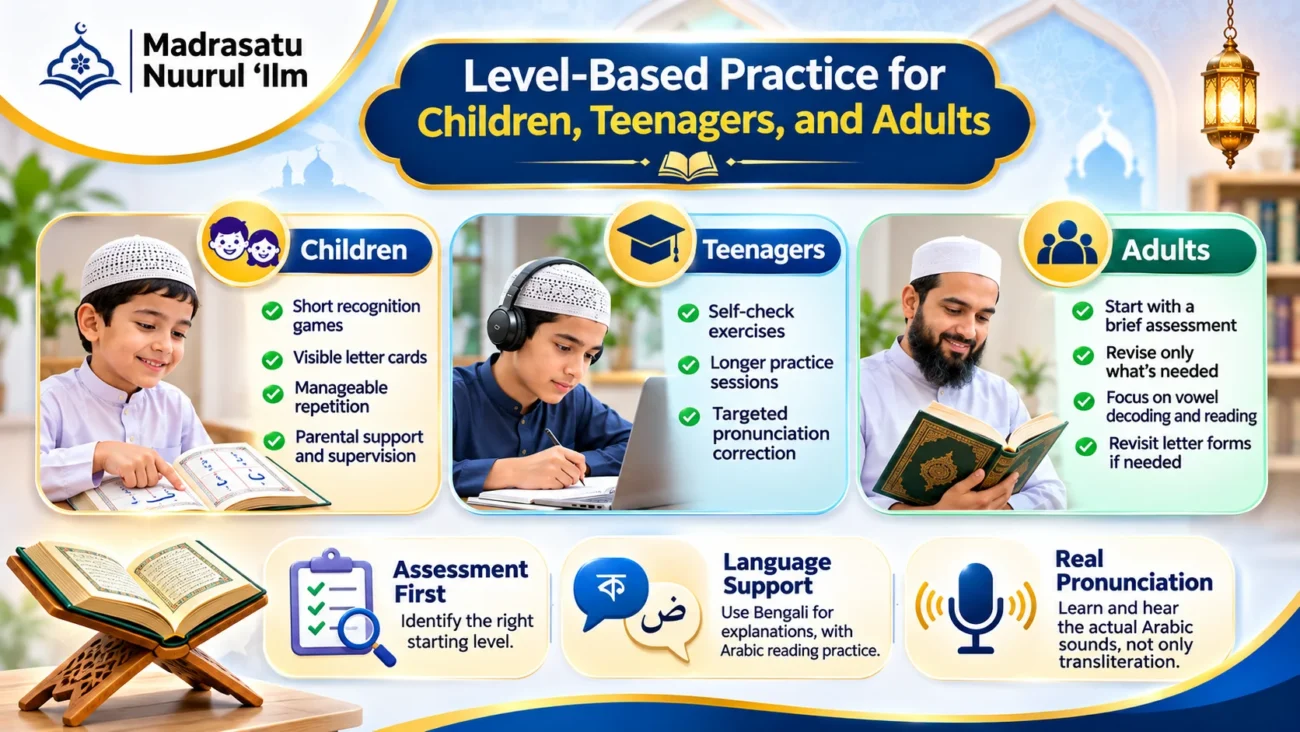
Level-Based Practice for Children, Teenagers, and Adults
Different learners can use the same curriculum without having identical activities. Younger children may respond well to short recognition games, visible letter cards, and manageable repetition. They may need a parent to prepare the device and help them remain in the learning space. Older students can often manage written self-checks and longer practice sessions, but they may still need targeted correction for Arabic sounds unfamiliar in their home language.
Adult beginners frequently ask if they should start from the very first letter even when they recognize some Arabic. A brief assessment helps. If they reliably identify all the necessary letters but cannot read with short vowels, the teacher can revise recognition quickly and devote more time to vowel decoding. If an adult recognizes printed Quranic words only from memorized surahs, a return to letter forms may be appropriate.
Language of instruction also matters. An expatriate Bengali family may benefit from explanations in Bengali while the student works with Arabic script. The teacher should still ensure that the student learns to hear and read actual Arabic sounds. Transliterated Bengali examples can offer a temporary explanation, but they should not become the main reading method.
Planning a Weekly Learning Routine by Level
No fixed practice schedule suits every family. A learner who attends one class each week may need a different home routine from someone attending several short live sessions. A schedule should account for age, homework load, energy, and the teacher’s expectations. Sessions can be brief when the goal is clear, and they should end before frustration replaces attention.
At Level 1, use mixed letter cards and a few pronunciation checks. At Level 2, compare connected shapes and locate letters inside examples. At Level 3, change vowel marks frequently so the student cannot simply recite a familiar pattern. At Level 4, use a few short combinations that contain targeted marks. At Level 5, listen to contrasting vowel lengths and carefully model the assigned rule. At Level 6, use unfamiliar but accessible reading lines and a brief review of recurring mistakes.
Consistency matters more than dramatic one-day practice sessions. Five calm minutes focused on a real difficulty can be valuable, while a long session spent reading incorrectly may reinforce a problem. Teachers and families should agree on which errors are appropriate for home revision and which require live correction.
Common Reasons Students Get Stuck Between Levels
The first common obstacle is superficial memorization. A student learns exactly how one line sounds but cannot read the same marks in a new arrangement. The solution is to vary examples. A second obstacle is insufficient listening practice. Students may know the printed symbol yet produce a familiar Bengali or English substitute sound. That requires guided articulation correction, not merely more silent reading.
A third problem is introducing too many rules simultaneously. If a learner has not understood short vowels, adding multiple types of madd may produce confusion. Teachers should diagnose which earlier skill is missing and return to it. A fourth problem is inconsistent practice, where the student forgets the previous class before the next one. Short reviews can help preserve continuity.
Finally, an unsuitable class pace can reduce confidence. Students who need an extra demonstration should be allowed to ask for one. A clear lesson objective and specific feedback reduce anxiety and support steady progress. A learning level should describe what a student needs, not label the student as good or bad.
How Parents Can Support Learning Without Teaching Incorrect Sounds
A parent who does not know Arabic fluently can still make a significant contribution. Help the learner prepare their materials, attend the session on time, and keep a visible record of assigned practice. Invite the child to explain the name of the current skill—letter recognition, joined forms, vowels, or shaddah—and celebrate genuine effort. Do not guess how unfamiliar Arabic letters are pronounced if you are unsure; ask the teacher to provide a reliable model.
When a child encounters frustration, keep the task smaller. Instead of insisting on a complete page, select a few examples and ask the student to identify what is difficult. Share recurring difficulties with the instructor. This partnership is especially helpful for families abroad whose home language differs from the language used in the child’s school. Quran education can remain a supportive part of family life without turning every practice session into an examination.
Choosing an Online Course With Clear Learning Levels
Before enrolling, ask how the academy assesses beginners and records progress. A clear answer should describe what happens at the first lesson, how errors are corrected, and how the teacher decides when to move forward. If a course only promises an extremely fast completion time, ask what independent reading skills students are expected to demonstrate. Strong teaching focuses on accuracy and confidence, not just completion speed.
Madrasatu Nuurul ‘Ilm describes a beginner-oriented progression covering letters and pronunciation, vowel and recitation marks, word formation, short reading practice, and revision. The academy provides Bengali-language guidance and online classes for children and adults. Families can view the Basic Online Noorani Qaida Course to see the program outline and discuss a learner’s starting point.
The suitable class frequency depends on availability and personal circumstances. Because published course schedules and fees can change, check the current class durations and monthly pricing before confirming enrollment. Overseas families should also agree on the time zone and communication method. Asking about these practical details early helps prevent interruptions later.
When Should a Learner Move to Quran Nazira?
The transition is most appropriate when a teacher can observe consistent decoding skills. The learner should recognize relevant letters in new contexts, read common vowel marks accurately, respond to sukoon and shaddah, and maintain reasonable awareness of the rules already studied. Reading should not depend entirely on remembering how a page sounded in a previous class.
Quran Nazira adds sustained reading from the Mushaf. Students learn to maintain accuracy across longer lines, adjust to Quranic typography, and apply rules within genuine recitation. Basic Qaida skills remain relevant. If a learner struggles after transitioning, revisiting one foundational skill is a normal and productive response.
The teacher’s judgment is more reliable than a blanket rule that every child must change courses at a particular age or on a particular date. An honest assessment protects both the learner’s progress and their confidence.
Frequently Asked Questions About Noorani Qaida Learning Levels
How many levels are there in Noorani Qaida?
There is no fixed universal number. Different publishers and teachers divide similar material into different lessons or modules. The six levels in this guide are a practical progression based on distinct reading skills, not an official standardized certification system. Always check how your chosen academy defines its levels.
What is the first level of Noorani Qaida?
The first level focuses on recognizing individual Arabic letters and beginning to pronounce them accurately. Students learn letter shapes, dots, and basic articulation. A good teacher checks recognition in random order rather than relying only on a memorized alphabet sequence.
Which Noorani Qaida level is the hardest?
The answer differs by learner. Some struggle with distinguishing similar throat sounds, while others find joined writing, sukoon, shaddah, or vowel length more demanding. The hardest stage is usually the one that exposes an earlier weakness requiring careful revision.
Can an adult skip beginner levels?
An adult can start at an appropriate point after assessment. Skipping material solely because of age is unwise, but repeating skills already demonstrated may waste lesson time. A teacher should check pronunciation and reading transfer before making that decision.
How do teachers know when a student should advance?
They test the target skill with unfamiliar examples and listen for recurring errors. A student who can read one memorized line may still need practice. Readiness involves reliable recognition, decoding, pronunciation, and response to correction across several examples.
Is finishing the last Qaida page enough to read the Quran?
Completing the final page is helpful but not a guarantee of independent Quran reading. A guided assessment and continued Nazira practice support the transition. Learners often need more practice with continuous reading, Quranic page layout, and Tajweed details.
Are online Noorani Qaida levels different from in-person levels?
The fundamental reading skills are the same. Online lessons may use screen sharing, digital practice material, and live audio feedback. Quality depends on clear sound, readable text, and a teacher who can identify pronunciation mistakes and respond effectively.
How can parents follow a child’s progress?
Ask the teacher for the current target, what the child can demonstrate independently, and the main difficulty to review. A simple introduced/practising/demonstrated checklist can be more useful than comparing the page number with another child.
How long does each level take?
No reliable fixed duration applies to every student. Age, prior Arabic experience, practice frequency, class length, and articulation difficulties all influence the pace. Consider skill-based milestones rather than an advertised universal completion date.
What comes after Noorani Qaida?
Many students move into supervised Quran Nazira reading, continuing Tajweed practice as their fluency improves. Others may need a short period of targeted revision first. The next course should be selected after the teacher evaluates the learner’s actual reading ability.
Start at the Right Level With Madrasatu Nuurul ‘Ilm
Understanding noorani qaida learning levels helps families ask better questions and set realistic expectations. For additional learning support, families can explore the free Learn How to Read Al-Qur’an guide, which provides structured Arabic reading exercises. The strongest progress is not the fastest progression through printed chapters; it is the steady development of transferable reading skills. A student who can recognize unfamiliar letters, decode marks carefully, and accept pronunciation feedback is building a foundation that supports future Quran reading.
Madrasatu Nuurul ‘Ilm offers live online learning for families looking for beginner Quran education and Bengali-language guidance. To discuss a child’s current level or your own starting point, use the academy’s free trial class form and ask the teacher what assessment and learning path would be appropriate. The trial is an opportunity to explore the teaching approach rather than a promise of a particular completion date.
Contact Madrasatu Nuurul ‘Ilm
Phone / WhatsApp: 01834-756502
Email: madrasatunurulilm912@gmail.com
Website: https://madrasatunurulilm.com/
Service: Online Noorani Qaida and Quran education for children, adults, and Bengali-speaking families internationally.
Next step: Request a learner assessment and ask about a free trial class.