
What Is Noorani Qaida? A Complete Beginner’s Guide to Learning Quran Reading


What is Noorani Qaida? Noorani Qaida is a structured beginner’s reading primer that introduces Arabic letters, their sounds, joining rules, short and long vowels, and selected foundations of Tajweed. It helps children and adults move from recognizing individual Arabic characters to reading simple Quranic words with greater accuracy. It is a starting point for Quran reading, not a replacement for advanced Tajweed study, Quran memorization, or understanding the Quran’s meanings.
For someone who has never studied Arabic, opening a page of the Quran can feel overwhelming. Letters change shape, small marks affect pronunciation, and some sounds do not exist in Bengali or English. Noorani Qaida breaks this challenge into manageable lessons. Instead of expecting a beginner to read full verses immediately, it teaches what each mark and letter contributes to a word. That orderly progression is the reason many families choose it for their first Quran lessons.
What Does Noorani Qaida Mean?
The word Qaida means a rule, foundation, or basic primer in this educational context. Noorani relates to light or illumination. Together, Noorani Qaida is commonly used as the name of an introductory method and booklet for learning to read Quranic Arabic. You may also encounter spellings such as Nurani Qaida, Noorani Qaidah, Norani Qaida, or Noorani Qaeda. In searches, these spellings generally refer to the same type of beginning reading material, although editions and lesson arrangements differ.
Noorani Qaida is not a separate Quran, a translation, or a collection of religious rulings. It is a teaching resource. Its primary purpose is to prepare a learner to recognize and pronounce the Arabic script used in Quranic recitation. Students initially study symbols in isolation, then combine them into meaningful reading patterns. As reading improves, the teacher introduces rules that protect the pronunciation and rhythm of recitation.
Why Is Noorani Qaida Important Before Reading the Quran?
A learner can recognize the shape of a letter without knowing how it should sound. Similarly, someone may memorize the pronunciation of a familiar surah but struggle when encountering an unfamiliar word. Noorani Qaida addresses both gaps by linking visual recognition with sound and guided reading practice.
Arabic has distinctive consonants made at different points in the mouth or throat. Consider the distinction between س and ص, or between ح and ه. A beginner may hear these pairs as nearly identical, particularly when learning through a Bengali or English approximation. Correcting those differences early helps prevent habits that are harder to change later. A teacher can demonstrate the sound, listen to the learner, and identify where an adjustment is needed.
Importantly, Noorani Qaida is a useful route into Quran reading, but it is not the only valid teaching method. Other established introductory primers can teach the same core skills. The quality of instruction, accuracy of feedback, and consistent practice matter more than any single book title.
Who Should Learn Noorani Qaida?
Noorani Qaida suits learners who need a reliable foundation in Quranic Arabic, whether they are starting for the first time or returning after a long break. A child may need help recognizing letters and staying engaged. A teenager may recognize letters but struggle with vowel marks. An adult may know a few short surahs by memory but still be unable to read unfamiliar lines. These are different starting points, yet all can benefit from foundational lessons selected for their ability.
Common learners include:
- Children beginning Quran education: Young learners can start with letter shapes, names, listening exercises, and short practice sessions suited to their attention and readiness.
- Adult beginners and returning students: Adults can build reading skills without embarrassment, reviewing basic sounds before progressing to full words.
- Bengali-speaking families abroad: Parents in the UK, USA, Canada, Australia, Germany, or Italy may prefer explanations in Bengali while their children practise the original Arabic script.
- New Muslims and learners without Arabic literacy: A teacher can introduce the script from the beginning rather than assuming prior familiarity with Arabic words.
- Students preparing for Nazira or Tajweed: Learners who identify individual letters but cannot read connected text can use Qaida practice to close that gap.

What Do Students Learn in Noorani Qaida?
Although the number of chapters varies by edition, most Noorani Qaida teaching follows a recognizable progression: letters, joining, short vowels, further marks, and supervised reading. The following table is a practical overview rather than a claim that every printed book contains identical chapter titles.
| Learning stage | Main subject | Skill the learner develops |
| Foundation | Individual Arabic letters and their names | Recognizes letters and distinguishes similar shapes |
| Pronunciation | Makharij, or articulation points | Produces sounds from the appropriate mouth or throat position |
| Letter connections | Initial, middle, final, and isolated forms | Recognizes letters inside connected words |
| Short vowels | Fatha, kasra, and damma | Reads consonants with the correct short vowel sound |
| Other marks | Tanween, sukoon, and shaddah | Reads endings, vowelless consonants, and doubled consonants |
| Length and flow | Madd, leen, and introductory Tajweed | Notices when sounds change in length or quality |
| Guided reading | Short words and simple Quranic passages | Applies multiple rules while reading unseen text |
Arabic Alphabet and Letter Recognition
The first practical task is to identify Arabic letters accurately. Standard descriptions of the Arabic alphabet usually count 28 basic letters, while some beginner primers teach hamza or related written forms separately and may display a different total. These counting conventions should not distract students from the actual goal: recognizing every sign they need to read in the Quran.
Beginners usually start with isolated letters such as ا, ب, ت, ث, ج, ح, and خ. The teacher helps them distinguish shapes and dot positions. For instance, ب has one dot below, ت has two dots above, and ث has three dots above. These visual clues are especially useful because many letters share a basic outline. Students also practise recognizing letters in a mixed order so they are not dependent on reciting the alphabet as a memorized sequence.
Makharij: Learning Where Arabic Sounds Come From
Makharij is the plural of makhraj, referring to the point of articulation of a sound. Arabic consonants are produced using different areas of the throat, tongue, lips, and related speech organs. A beginner must learn not only the name of a letter but also the physical way its sound is produced.
For example, ب uses the lips, while ت involves the tongue touching the area near the upper front teeth. ح is produced in a different throat position from ه. The letters ق and ك are also not interchangeable. Reading the letters aloud with an experienced teacher is more dependable than guessing their sounds from English or Bengali transliterations.
Joined Letters and Changing Shapes
Arabic writing runs from right to left, and many letters connect with neighboring letters. A letter may look different at the beginning, in the middle, and at the end of a word. For example, ب can appear as ب, بـ, ـبـ, or ـب depending on its position and connections. The underlying letter remains the same even when its outline changes.
Not every letter connects on both sides. Letters such as ا, د, ذ, ر, ز, and و do not connect to a following letter on their left in ordinary Arabic joining. Students learn to recognize where a visual break is expected rather than treating it as a separate word. These joining rules are essential because Quranic Arabic is normally encountered as connected text, not as a row of individual alphabet cards.
Harakat: Fatha, Kasra, and Damma
Arabic short vowels are commonly represented by marks called harakat. Fatha (َ) produces a short /a/-type vowel, kasra (ِ) a short /i/-type vowel, and damma (ُ) a short /u/-type vowel. For example, بَ, بِ, and بُ each begin with the same consonant but have different vowel sounds. Exact pronunciation should be learned by listening rather than equating the sounds perfectly with English vowel letters.
Learners need to see that a tiny written mark can change how a word is spoken. A practical exercise is to keep one consonant constant and change its short vowel. The teacher can then reverse the activity: pronounce a syllable and ask the student to select the matching written form. Combining recognition and listening helps strengthen recall.
Tanween, Sukoon, and Shaddah
After short vowels, Noorani Qaida commonly introduces tanween: double vowel marks that normally add an /n/ sound in connected pronunciation, subject to the relevant recitation rules. Students see forms such as ـً, ـٍ, and ـٌ. They must later learn how stopping at the end of a word can affect the way certain endings are read.
Sukoon (ْ) indicates that a consonant has no following short vowel. A beginner should avoid automatically adding an extra vowel after that consonant. Shaddah (ّ) indicates a doubled consonant, often explained as a combination of a consonant with sukoon followed by the same consonant carrying a vowel. These concepts become much clearer when students hear paired examples and repeat them slowly.
Madd, Leen, and Early Tajweed Awareness
Madd refers to prolonging a vowel sound according to recitation rules. Under the relevant conditions, alif, waw, and ya function as madd letters. A foundational lesson introduces ordinary long-vowel patterns before students study more detailed categories and their different lengths. Teachers may also introduce leen, involving a sakin waw or ya preceded by fatha, and explain its pronunciation in suitable examples.
Beginners may encounter other foundational ideas such as qalqalah, the characteristic release of certain sakin consonants, or ghunnah, a nasal sound in specified contexts. These topics require attentive listening. They are not an invitation to lengthen every vowel, bounce every letter, or add nasalization wherever it seems pleasing. The correct rule depends on the letters and their position.
Noorani Qaida vs Quran Nazira vs Tajweed vs Hifz
These terms are often used together on Quran academy websites, which can confuse first-time parents. They describe related but distinct skills. The easiest way to understand the difference is to ask what a learner is expected to do by the end of each stage.
| Learning path | Main focus | Typical outcome |
| Noorani Qaida | Alphabet, pronunciation, symbols, word formation | Reads beginner-level Arabic words more accurately |
| Quran Nazira | Reading directly from the Quran while looking at the text | Builds sustained Quran reading fluency and accuracy |
| Tajweed | Rules governing correct Quranic recitation | Improves precision and consistency in recitation |
| Quran Hifz | Memorizing Quranic passages with ongoing revision | Retains assigned verses from memory |
The paths overlap. A Nazira student still needs correct pronunciation; a Hifz student must also pay attention to Tajweed. However, a beginner who cannot yet identify letters usually needs foundational reading instruction before attempting extensive independent Quran reading. After becoming comfortable with basic Qaida exercises, students can progress to the Complete Quran Nazira Course and build the ability to read from the Mushaf with teacher supervision.
Students who already read Arabic but make recurring pronunciation errors may need focused Quran learning with Tajweed instead of repeating every beginner lesson. The right path should depend on an assessment of actual reading ability, not simply the learner’s age or the number of years they have attended classes.
How to Learn Noorani Qaida Step by Step at Home
Begin by setting up a quiet space with a clearly printed Qaida book or legible digital page. Place the screen or book where letters and vowel marks are easy to see. Ideally, the learner should hear a knowledgeable teacher pronounce the target sound before attempting it. Recordings can help with review, but a recording cannot tell a learner when their own pronunciation is incorrect.
A practical home-learning routine:
- Review for a few minutes: Revisit letters or marks learned previously, including examples the learner missed in the last lesson.
- Practise one focused skill: Listen to the teacher’s model, read the assigned examples, and repeat difficult sounds at a comfortable pace.
- Test with a new example: Ask the learner to recognize or read an unfamiliar combination, then note what needs correction at the next class.
A Realistic Four-Week Starter Plan
A beginner’s first month can be organized around foundational skills without promising that everybody will reach the same lesson. The schedule below is an illustrative plan, not a guaranteed result or a fixed official course syllabus.
| Period | Suggested focus | Progress check |
| Week 1 | Recognize isolated Arabic letters | Identify familiar letters in random order |
| Week 2 | Practise makharij and distinguish similar sounds | Repeat teacher-modelled contrasts more accurately |
| Week 3 | Explore connected letter forms and short vowels | Decode simple combinations with guidance |
| Week 4 | Review earlier lessons and add suitable reading exercises | Read a short unfamiliar line at the learner’s level |
How Long Does It Take to Complete Noorani Qaida?
There is no universally correct completion period. Duration depends on how often classes occur, the learner’s prior experience, age, practice between sessions, pronunciation needs, and the teacher’s approach. Two learners attending the same number of classes can progress at very different speeds. Some may master new letters quickly but need more time with connected text; others may recognize the script well yet struggle with unfamiliar Arabic sounds.
A better question than “How many weeks will it take?” is “What should the student be able to read independently before moving on?” A useful readiness check includes accurate letter recognition, basic use of vowel marks, awareness of joining patterns, and the ability to read unfamiliar beginner-level combinations under teacher assessment. These are observable skills rather than arbitrary calendar targets.
Common Noorani Qaida Mistakes and How to Correct Them
Frequent mistakes include:
- Confusing similar letters: Mixing up ب, ت, and ث because their underlying shapes resemble one another; or treating س and ص as identical sounds.
- Relying only on transliteration: Reading a Bengali or English approximation instead of looking closely at the Arabic text and listening to correct pronunciation.
- Adding or shortening sounds incorrectly: Inserting a vowel after a sakin consonant, overlooking shaddah, or failing to distinguish ordinary short vowels from madd patterns.
- Rushing beyond current ability: Memorizing a lesson’s sequence without recognizing the same symbols in new combinations.
- Skipping teacher feedback: Repeating an incorrect pronunciation many times because no qualified listener has checked it.
Correction should be specific. Instead of saying only “Read it properly,” a teacher can identify the exact letter or mark and demonstrate the difference. Learners can practise it in isolation, then inside a word, and finally in a short reading sequence. This gradual approach helps students understand what changed and why.
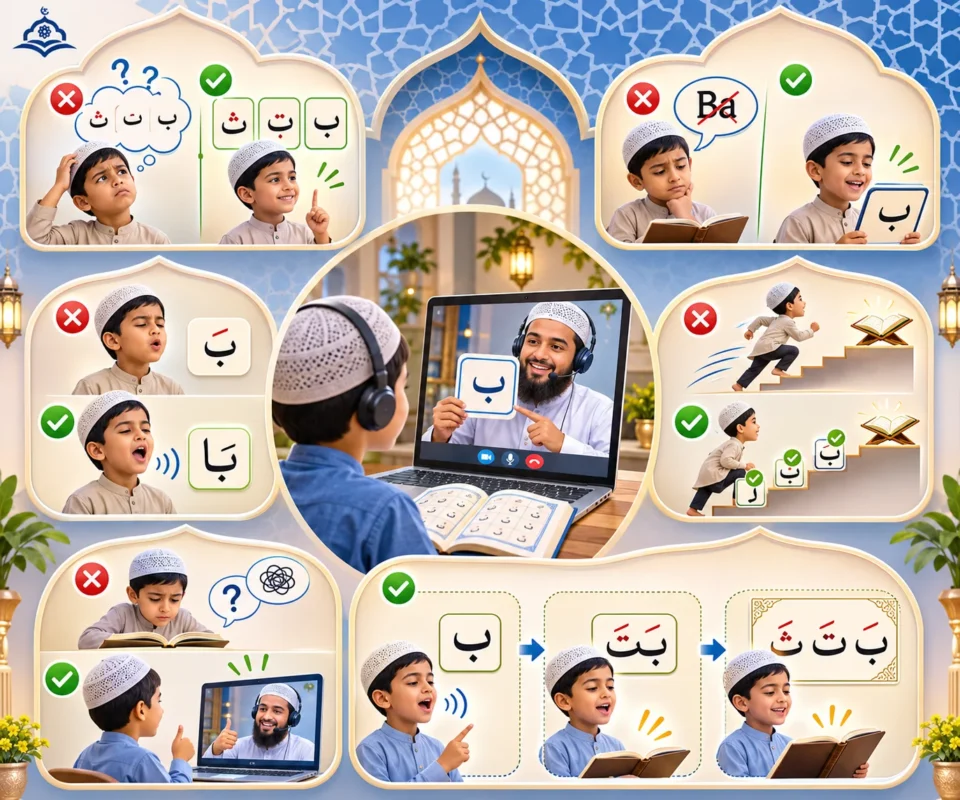
Can Children and Adults Learn Noorani Qaida Online?
Yes. Online instruction can work for beginners when the teacher and learner can see the lesson material clearly, hear one another reliably, and spend enough time on individual corrections. A live class can also help parents understand exactly what the student should practise between sessions. The medium does not remove the need for good teaching; it simply allows lessons to be delivered across distance.
For children, engagement often improves when instruction uses short tasks, a warm tone, visual letter recognition, and manageable repetition. Parents can help prepare the device, reduce distractions, and establish a routine. Very young learners may need a caregiver nearby, especially during the first few sessions. Lessons should be adjusted to the child’s developmental readiness rather than assuming every child can concentrate for the same duration.
For Bengali-speaking households living abroad, online classes can also bridge a language gap. Parents may prefer guidance in Bengali even when their children use English at school. Clear communication about homework, progress, and time zones makes the experience more manageable for families in the UK, USA, Canada, Australia, Germany, and Italy. Availability of a particular time slot should always be confirmed before enrollment.
What Should You Look for in an Online Noorani Qaida Teacher?
Not every online course offers the same experience. The most important question is whether the teacher can listen carefully and help the student correct real reading mistakes. An attractive website or video lesson library may be useful, but neither proves teaching quality on its own.
Before enrolling, ask how the teacher assesses a beginner. A credible approach starts by checking letter recognition and pronunciation rather than automatically placing every new student on page one. Ask whether lessons include live reading, correction, revision, and clear feedback. Parents should also understand the expected role of an adult during a child’s online class, the class length, and what happens when a session must be rescheduled.
Learning Noorani Qaida at Madrasatu Nuurul ‘Ilm
Madrasatu Nuurul ‘Ilm provides online Islamic education for learners at different levels, including children, adults, and Bengali-speaking families living outside Bangladesh. Its Noorani Qaida offering introduces basic Arabic letters, pronunciation, harakat, and early Quran-reading skills with guidance from teachers. The published course description also discusses live interaction, feedback, and practice suited to beginners.
Students who are new to Arabic can explore the Basic Online Noorani Qaida Course to see how its learning foundation is organized. The academy promotes a free trial class, allowing prospective students and parents to experience online learning before choosing a course. Because individual circumstances differ, families should confirm current teacher availability, timing, class format, and the details of any learning plan during enrollment.
Course duration and monthly fees may depend on the chosen schedule and class length. Rather than relying on a quoted price that may become outdated, readers can check the academy’s published class pricing and schedule options and confirm the applicable arrangement directly. This is especially useful for international households coordinating local time zones and payment arrangements.
Frequently Asked Questions About Noorani Qaida
What is Noorani Qaida in simple words?
Noorani Qaida is a beginner’s guide to reading Arabic for the Quran. It teaches letters, pronunciation, vowel marks, joining patterns, and introductory reading rules in a sequence that is easier to follow than starting with full Quranic passages. Its main goal is basic reading readiness, not translation or memorization.
Is Noorani Qaida part of the Quran?
No. Noorani Qaida is an educational primer used to prepare students to read Quranic Arabic. It may include Arabic examples and selected Quranic material for practice, depending on the edition, but the primer itself is not a chapter or separate part of the Quran.
How many Arabic letters are taught in Noorani Qaida?
The standard Arabic alphabet is generally described as having 28 basic letters. Some teaching materials count or present hamza and related written forms separately, which can lead to a different figure in a beginner lesson. A good course teaches all relevant forms needed for accurate Quran reading regardless of the counting convention.
Do you need to know Arabic before learning Noorani Qaida?
No prior Arabic reading ability is required. The method begins with the alphabet, making it suitable for genuine beginners. However, someone who already recognizes letters may start at a more advanced lesson after a teacher checks their pronunciation and understanding of vowel marks.
Is Noorani Qaida only for children?
No. Children, teenagers, adults, and older learners can all study Noorani Qaida. Teachers should adapt the lesson pace, examples, and explanations to the individual’s age and experience. Adult learners do not need to follow the same classroom approach as young children.
Can I learn Noorani Qaida without a teacher?
Books, charts, and recordings can help you recognize letters and practise reading patterns, but a teacher is strongly recommended for pronunciation. Several Arabic sounds are difficult to judge using transliteration alone. Live feedback helps identify errors that independent reading or recorded audio cannot detect.
Is Noorani Qaida the same as Tajweed?
No. Noorani Qaida builds elementary letter recognition and Quran-reading skills while introducing selected Tajweed foundations. Tajweed is a wider body of recitation rules, including detailed pronunciation, elongation, nasalization, and other context-dependent features. Learners often continue studying Tajweed after mastering the Qaida basics.
Is Noorani Qaida enough to read the complete Quran?
It is a foundation, not a guarantee of full fluency. Completing a primer may prepare a learner to begin reading from the Mushaf, but sustained accuracy and confidence require supervised Nazira practice, repetition, and continued attention to Tajweed. A teacher should assess readiness before moving to extensive Quran reading.
What comes after Noorani Qaida?
Many students proceed to Quran Nazira, where they practise reading directly from the Quran while looking at the Arabic text. Continued Tajweed study helps refine pronunciation and rule application. Students interested in memorization can later pursue a Hifz pathway suited to their reading ability and learning goals.
How much should a beginner practise each day?
Short, consistent practice is generally more manageable than occasional long sessions. A family might start with ten to fifteen minutes of focused revision and adjust it to the learner’s attention and needs. Pronunciation feedback remains more important than accumulating minutes.
How can parents help if they cannot read Arabic?
Parents can provide a quiet space, encourage punctual attendance, ask the child to show the day’s lesson, and communicate with the teacher about difficult topics. They should avoid correcting unfamiliar Arabic sounds from guesswork. A supportive home routine is useful even when the parent is learning alongside the child.
Are online Noorani Qaida classes suitable for families living abroad?
They can be. Online lessons remove the need for travel and can connect families with teachers who explain concepts in a familiar language. Students still need an appropriate schedule, reliable audio, a readable lesson display, and a teacher who can offer individual correction. Confirm local class times before booking.
Can adults start Noorani Qaida after learning some surahs by memory?
Yes. Memorizing a familiar surah and independently reading unfamiliar Arabic are different skills. Adults who know verses by heart can still benefit from learning individual letters, vowel marks, joining rules, and correct pronunciation. An assessment can identify which fundamentals need review.
How can I know when a student is ready to leave Noorani Qaida?
Readiness is best judged by performance with unfamiliar examples. The learner should recognize relevant letters, interpret common marks, combine letters with reasonable accuracy, and respond to pronunciation corrections. A supervised transition to Quran Nazira is preferable to relying only on completion of the last printed page.
Start Your Noorani Qaida Learning Journey
Understanding what is Noorani Qaida is only the first step. The real progress comes when a learner identifies Arabic letters accurately, practises their sounds consistently, and begins reading connected text with informed guidance. Whether you are a parent helping a child start Quran education or an adult returning to the alphabet, patient instruction can make the learning process clearer and less intimidating.
Madrasatu Nuurul ‘Ilm welcomes inquiries from beginners and families looking for online Quran education with Bengali-language support. Explore the Noorani Qaida learning pathway, discuss your current reading level, and ask about a free trial class before selecting a suitable schedule. For additional reading practice, families can explore the free Noorani Qaida learning book from the Australian Islamic Library. A strong foundation today can support more confident Quran reading in the years ahead.
Contact Madrasatu Nuurul ‘Ilm
Phone / WhatsApp: 01834-756502
Email: madrasatunurulilm912@gmail.com
Website: https://madrasatunurulilm.com/
Service: Online Quran and Islamic education for children and adults, including international Bengali-speaking families.
Next step: Contact the academy or use the Free Trial form on the website to ask about beginner Noorani Qaida classes.