
Noorani Qaida Alphabet Lesson: Recognize Every Arabic Letter


A Noorani Qaida alphabet lesson introduces the Arabic letters used in Quran reading and teaches beginners how to recognize their shapes, names, dot patterns, and basic visual differences. In the standard convention, Arabic has 28 basic alphabet letters; some teaching primers also present hamza separately. The first goal is reliable recognition of the written letters, not immediate fluency in full Quranic verses. Learners should be able to identify letters in different orders and begin connecting each symbol to its correct sound.
A new student may open a Qaida book and see a compact collection of unfamiliar characters. Some are distinguished by one extra dot; others have a similar shape but a different orientation or loop. At first, memorizing a neat alphabet row seems enough. The challenge appears when the same letters are rearranged on a worksheet or shown inside a new word. This guide therefore focuses on how to see Arabic script accurately, how to organize effective recognition exercises, and how to help children or adults build familiarity before they attempt longer reading passages.
What Is Taught in the First Noorani Qaida Alphabet Lesson?
The alphabet stage is sometimes called huroof mufradat, meaning individual or separate letters. The learning material may show one symbol at a time, a complete chart, or groups of letters with similar features. The exact page numbering varies between editions, so parents should not assume that Lesson 1 in every book is arranged identically. The learning outcome is more consistent: students begin to identify and distinguish the Arabic characters they will later meet in Quranic text.
A teacher may pronounce each letter’s name, model the sound, and ask the learner to locate the corresponding shape. New students should learn that a letter name is not always the same thing as a letter’s sound when combined with vowel marks. At this stage, the teacher should avoid overwhelming the learner with every later recitation rule. Recognizing a character carefully and noticing its dots is a meaningful achievement on its own.
The alphabet lesson also gives the instructor a chance to observe how the learner processes visual information. Does the student remember a letter’s outline but forget its dots? Can they identify the same character in a different typeface? Do they confuse a mirrored shape, or rely on its position in a familiar row? These observations help determine which practice tasks will be most helpful.
The 28 Arabic Alphabet Letters at a Glance
Most introductory resources present the letters from alif to ya. The following chart provides the basic written forms and common English names; transliteration is an aid to identification and should not be treated as a complete pronunciation guide. Actual Arabic sounds should be learned by listening to a qualified teacher, especially for letters that do not have a direct equivalent in English or Bengali.
| Letter | Common name | Letter | Common name |
| ا | Alif | ب | Ba |
| ت | Ta | ث | Tha |
| ج | Jim | ح | Ha (ḥā) |
| خ | Kha | د | Dal |
| ذ | Dhal | ر | Ra |
| ز | Zay | س | Sin |
| ش | Shin | ص | Sad |
| ض | Dad | ط | Ta (ṭā) |
| ظ | Za (ẓā) | ع | Ayn |
| غ | Ghayn | ف | Fa |
| ق | Qaf | ك | Kaf |
| ل | Lam | م | Mim |
| ن | Nun | ه | Ha (hā) |
| و | Waw | ي | Ya |
Hamza (ء) has an important consonantal sound and appears in Quranic orthography; some Qaida charts present it separately from the standard 28-letter sequence. Learners should follow the book and teacher’s convention rather than worrying about whether a chart counts 28 or 29 items. The educational objective remains the ability to recognize relevant symbols accurately. The different spellings of English letter names also do not change which Arabic letter is being studied.
Why the Dots Matter So Much
Dot position and number distinguish several Arabic letters sharing similar underlying shapes. For example, ب has one dot below, ت two dots above, and ث three dots above. Another group includes ج, ح, and خ, where dot presence and position change the identification. The letters ف and ق are also commonly contrasted by appearance, though the exact dot representation in some regional writing styles can differ.
Beginners benefit from tracing an outline mentally before looking at the dots. What is the shared body? Where is the dot: above, below, or absent? How many dots are present? Once a student sees the pattern, a collection of apparently unrelated characters becomes easier to organize. This kind of recognition exercise is not merely an artistic activity. It supports accurate decoding when the learner meets unfamiliar Quranic words later.
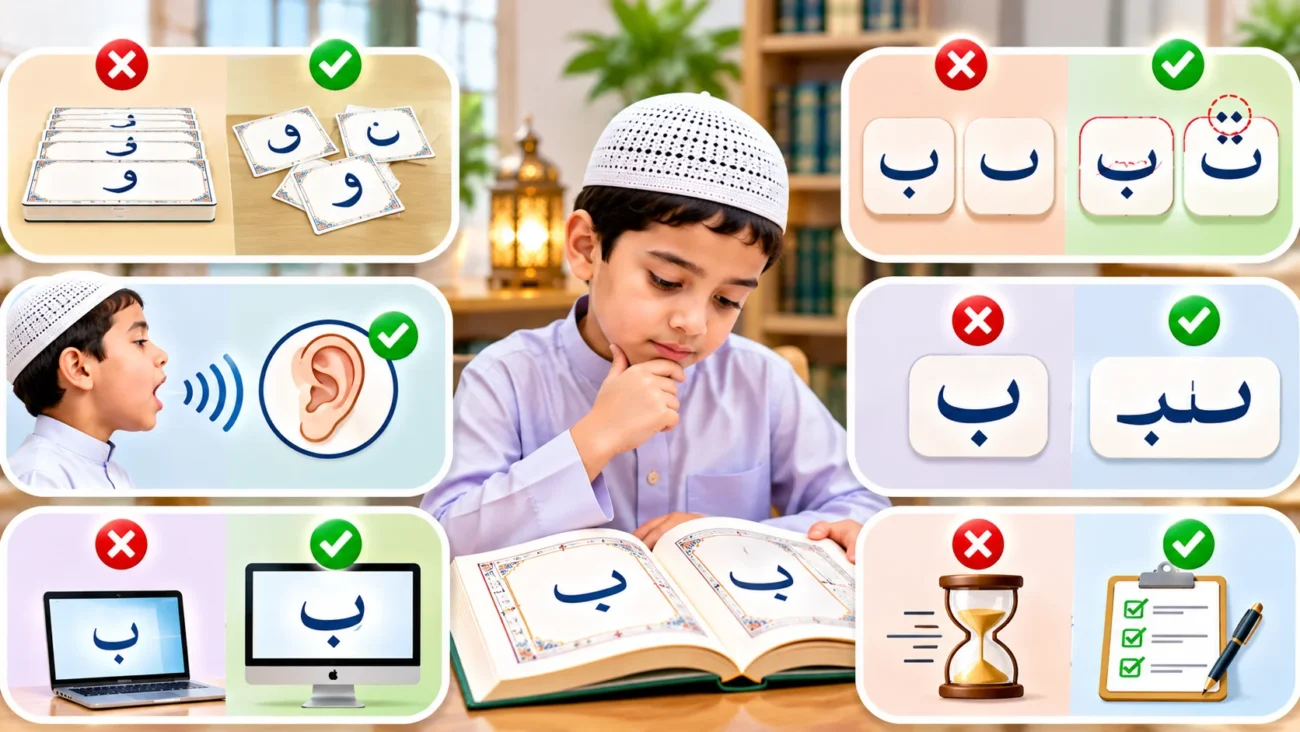
A useful teacher-led exercise starts with three cards that have the same base shape. The teacher shows one card for a moment, turns it over, and asks the student to identify which dot pattern was visible. Another exercise uses a row of mixed symbols and invites the learner to find every instance of a particular letter. The purpose is to train deliberate attention, not to reward speed.
Group Arabic Letters by Visual Families
Teaching the full alphabet as one uninterrupted list may be manageable for some students but confusing for others. Visual families provide a different route into recognition. Related letters share an outline and differ through dots, tails, or other features. Grouping them also encourages students to explain what they see instead of simply repeating a remembered name.
| Visual family | Examples | Recognition focus |
| Bowl-shaped letters | ب ت ث | Number and position of dots |
| Curved descending group | ج ح خ | Dots inside, above, or no dot |
| Short bent forms | د ذ | Presence of the dot |
| Curved tail forms | ر ز | Dot above versus none |
| Wavy forms | س ش | Three dots distinguish shin |
| Broad forms | ص ض | Dot above distinguishes dad |
| Upright heavy forms | ط ظ | Dot above distinguishes ẓā |
| Loop forms | ع غ | Dot above distinguishes ghayn |
These are practical teaching groups, not separate formal categories of the Arabic alphabet. The instructor may choose another grouping if a student recognizes that arrangement more easily. A learner should eventually be able to identify each letter outside its family. Otherwise, recognizing a three-card group might mask an inability to recognize the same symbol when it appears alone.
Separate Letter Names From Sounds
The alphabet chart introduces names such as ba, ta, and jim, but a beginner will eventually need to read consonants with vowel marks. In Arabic, the letter’s name and the sound it contributes to a syllable are related yet not interchangeable. Saying the name “ba” is not the same as reading every instance of ب regardless of its accompanying signs.
A teacher should therefore model letter names accurately and gradually prepare students to distinguish recognition from actual reading. This distinction prevents a common problem: a learner who memorizes the names beautifully but continues naming letters when asked to decode a word. Simple oral prompts can separate the tasks. “Which letter is this?” calls for the name. “Read it with the mark above it” becomes appropriate after vowels are introduced.
Parents who do not speak Arabic can reinforce shape recognition without inventing pronunciation rules. They might hold up a card and ask the child to point to the correct matching letter in the book. The sound itself should be checked through teacher guidance. That division of responsibilities keeps home practice productive and reduces the risk of reinforcing inaccurate articulation.
Learn the Arabic Alphabet in the Correct Reading Direction
Arabic is read from right to left, unlike English and Bengali text that is commonly approached left to right. Young students may instinctively scan a sequence in the wrong direction when they move between schoolwork and Qaida practice. Directionality should be introduced gently and repeatedly through consistent page use.
Show the first letter on the right, then guide the eye toward the left. The teacher can trace under a short row with a finger or pointer while naming the letters. Avoid speeding through a long row until the student is comfortable tracking the sequence. Some printed charts have their own practice arrangement for recognition, but the direction used in actual Arabic words remains right to left.
An effective check is to present a short sequence of separately written letters and ask the learner to indicate which would be encountered first in normal reading. If the student hesitates, spend a moment practising direction alone. It is a small skill that can influence later word reading significantly.
When to Introduce Initial, Middle, and Final Forms
After isolated letter recognition becomes reliable, the next visual task is understanding how many Arabic letters change shape when they join. For example, ب can appear as ب, بـ, ـبـ, and ـب, according to its place and neighboring letters. The familiar identity remains, but the form becomes more compact. This is a bridge between alphabet study and genuine word decoding.
Not all letters attach to a following letter on their left. In ordinary Arabic joining, ا, د, ذ, ر, ز, and و are familiar examples that do not connect onward. Students should see these letters inside short sample words so they understand that a break in written joining is normal. An important recognition exercise is to find the same known letter in a variety of connected arrangements.
Do not rush into complicated word formation while the learner still struggles with basic letter identification. An alphabet lesson works best when its goal is clear. Introduce joining as a preview, then assign the detailed combinations to a later reading lesson. This approach makes content easier to absorb and helps avoid repeated confusion.
Five Practical Exercises for Arabic Letter Recognition
These activities work best after the teacher has introduced the relevant letters:
- Mixed-card identification: Place familiar letters in a new order and ask the student to name each one. Change the positions during every practice session.
- Dot detective: Show a set of letters sharing an outline and ask the student to describe the number and location of dots before identifying them.
- Find the letter: Give the student a simple printed row and ask them to circle each occurrence of a particular Arabic character.
- Match the family: Invite the learner to group related letters by shape, then describe the visual clue that distinguishes each family member.
- Teacher sound match: Let the teacher pronounce a sound while the student points to the letter; this adds listening practice without requiring a parent to invent an Arabic approximation.
Each activity should be short enough for the learner to stay attentive. Vary the task before fatigue builds. An activity that was effective yesterday may feel too easy tomorrow, which is a sign to introduce a slightly more demanding recognition challenge. The alphabet is the foundation of subsequent reading, so fluency matters, but the progression should remain supportive.
An Alphabet Practice Routine for Young Children
Children may learn letter identities through brief activities rather than sustained drills. A parent can display three known letters, invite the child to find a match, and celebrate an accurate response. Then the teacher may add one unfamiliar letter with a distinct shape. Focusing on a small set reduces cognitive overload and allows the child to notice differences.
Set up a quiet space and reduce unnecessary screen distractions during online lessons. A printed chart can remain visible between classes, but it should be used for active recognition, not simply as a wall decoration. Ask the child to point to a letter named by the teacher or identify a letter seen in an unfamiliar arrangement. Children often enjoy succeeding at a clear, manageable challenge.
Parents should not require long sessions merely because a larger amount of practice seems impressive. A few attentive minutes can be more effective than a frustrated half hour. If the child has trouble with a particular group, tell the teacher what happened and ask which visual exercise would be appropriate. Consistency and accurate feedback matter more than a rigid daily target.
A More Efficient Alphabet Approach for Adults
Adult learners often bring useful study habits but may feel embarrassed about beginning with elementary letters. The alphabet is not childish; it is simply a new writing system. Adults can benefit from a systematic comparison chart, noting which letters are visually distinct, which share a base shape, and which cause confusion. A short self-test at the end of a session reveals whether recognition is becoming automatic.
Adults should resist the temptation to rely exclusively on English or Bengali spellings of Arabic names. Transliteration can introduce a letter, but it does not fully represent Arabic sound distinctions. Combine text recognition with a good audio model and teacher feedback. If a letter is already familiar, practise finding it in a different font or a connected form rather than repeatedly memorizing its place in the alphabet order.
A tutor can also adjust the pace. An adult who recognizes the letters from earlier childhood study may be able to spend less time on basic shapes and more time on pronunciation correction. Another adult may prefer starting with a few letters each week. Neither route is inherently superior when the learning outcome is accurate, transferable recognition.
Common Mistakes in the Noorani Qaida Alphabet Lesson
One frequent error is memorizing the printed order without knowing the symbols independently. To test this, rearrange the letters. Another is ignoring dots, especially when similar forms are shown together. Ask the learner to describe dots before naming the letter. A third is assuming that a similar Bengali or English sound means two Arabic letters are interchangeable. This is primarily a pronunciation issue that should be corrected through listening and articulation work.
Learners may also confuse the isolated shape with a joined form, assume every written form connects to a following letter, or become distracted by unfamiliar digital fonts. These are expected difficulties when learning a new script. They deserve targeted exercises rather than repeated instructions to “look carefully.” An effective teacher identifies the exact visual decision the learner is missing.
Finally, speed-based competition can distort the learning goal. A child who pauses to examine the dots may be processing the word correctly. Over time, the pause should shorten as recognition improves. Rushing too early can create a habit of guessing, which is difficult to undo once the learner begins Quran reading.
How Do You Know the Alphabet Has Been Learned?
Completion of one chart does not automatically mean mastery. A teacher should be able to show familiar letters in a random order, and the learner should identify them with reasonable accuracy. The student should also notice dot differences and avoid repeatedly confusing specific families. If letter names are known but pronunciation remains inaccurate, the recognition skill may be developed while the sound skill still needs more work.
A simple assessment uses two short rounds: one with isolated letters and one with familiar letters displayed in a different sequence or typography. The teacher records errors, then chooses a small revision target. This is preferable to repeatedly re-teaching the entire alphabet when only one group is causing difficulty.
Parents can observe the process even without knowing Arabic. Does the teacher vary the examples? Does the learner correct an error after explanation? Is there a specific plan for the next session? These questions provide better information than a page number or a claim that the alphabet was finished in a few days.
From Alphabet Recognition to Reading With Harakat
The next stage usually introduces connected forms and vowel marks. Fatha, kasra, and damma attach to letters and influence their short vowel sounds. A student who knows the letter ب must learn that بَ, بِ, and بُ are read differently. The alphabet lesson has prepared the learner to see the stable consonant while noticing the additional written mark.
This transition should be practical. A teacher can show one known letter with changing short vowels, then expand the exercise to several consonants. The learner is no longer only identifying a symbol; they are beginning to decode syllables. Some children feel that this is an entirely new skill, which explains why patient revision matters even after successful alphabet study.
Eventually, reading expands to tanween, sukoon, shaddah, madd, and joined words. Those topics are outside the main focus of this alphabet article. For a full beginner learning pathway, families can explore the Basic Online Noorani Qaida Course offered by Madrasatu Nuurul ‘Ilm.
Choosing Print, Digital, and Flashcard Materials
The best beginner material is clear, accurate, and readable. A large print chart makes shapes easier to distinguish, while digital zoom can help when a student is learning remotely. Color highlights may be useful for comparison, but they should not change the correct printed form or teach that a color has a religious meaning. The symbol itself must remain the focus.
For flashcards, use a consistent Arabic typeface initially and add alternative fonts after recognition improves. Keep the cards uncluttered. Avoid putting a long English phonetic description beside every character if that causes students to look at the approximation instead of the Arabic letter. It can be helpful to place the letter name on the reverse side and use it only for checking.
Worksheets can support visual matching and tracing, but they cannot establish correct pronunciation on their own. An educational app or recorded voice is also limited: it cannot reliably detect whether a learner has produced ح or ه from the correct articulation point. Live instruction remains valuable for checking actual sound production.
Making Alphabet Lessons Work for Families Abroad
Families living outside Bangladesh often juggle school schedules, work, and different spoken languages. A child may speak English at school and Bengali with relatives while learning Quranic Arabic. This does not prevent progress, but the teacher should make instructions clear and avoid mixing transliteration systems unpredictably. Consistent Arabic script should remain central.
A Bengali-speaking instructor can explain the distinction between similar shapes in a familiar language and demonstrate the original Arabic sound directly. Parents can support recognition at home with visual tasks even when their own Arabic reading is limited. The goal is a sustainable learning routine that fits the family’s schedule rather than a course that creates unnecessary pressure.
If your household is in the UK, USA, Canada, Australia, Germany, or Italy, confirm class timing in your local time zone. For published options, visit the academy’s pricing and class schedule page and check current arrangements before enrolling.
How Noorani Qaida Alphabet Practice Supports Quran Nazira
When a learner recognizes letters automatically, more attention becomes available for vowels, pronunciation rules, and continuous reading. That is why alphabet practice is not a separate decorative stage; it prepares the learner to read real text. Accuracy in letter identification reduces mistakes later when letters appear in connected Quranic words.
A student should not move directly from naming single letters to long unsupervised passages. The intervening steps—joining, vowels, sukoon, shaddah, and gradual decoding—matter. Once those foundations become dependable, the academy’s Complete Quran Nazira Course can provide supervised practice reading directly from the Quran.
For learners who already know letters but need pronunciation correction, the next step should be selected by assessment rather than age. Some may need work on makharij before a full Nazira transition. This flexible approach respects individual strengths without losing the essential foundations.
Frequently Asked Questions About the Noorani Qaida Alphabet Lesson
Does Noorani Qaida have 28 or 29 letters?
The standard Arabic alphabet has 28 basic letters. Some teaching primers count hamza separately and therefore show 29 items. These are presentation and counting conventions, not competing versions of Quranic Arabic. The learner should recognize all relevant signs used in the material.
Which letters should a beginner learn first?
Most primers begin with the standard alphabet order, but teachers may spend additional time on visually related letters. The most useful starting point is a small set the learner can recognize reliably. A teacher can then build toward the complete set rather than overwhelming a new student.
Should students memorize the alphabet in order?
Learning the order is useful, but it is not sufficient. Students should also identify letters shown in random order and different contexts. Otherwise they may reproduce the chart from memory without being able to read a new word.
Are dots more important than letter shapes?
Both matter. The core shape helps a learner identify a letter family, while dots distinguish members of that family. A reliable reader notices the entire form, including the number and placement of dots.
Can an adult learn Arabic letters online?
Yes. Adults can learn visual recognition through live classes, clear charts, and regular self-tests. Pronunciation should also be checked by a qualified teacher because transliteration and recorded materials cannot provide individual correction.
What is the difference between alif and hamza?
Alif (ا) has important orthographic and vowel-length functions, while hamza (ء) represents a consonantal glottal stop and may be written on or around different carriers. An introductory chart may simplify this relationship, but accurate instruction should distinguish their functions when vowel reading is introduced.
When do students learn joined Arabic letters?
Usually after isolated letter recognition is reasonably stable. Teachers show the initial, medial, and final shapes and explain letters that do not connect onward. The sequence may differ by book, so readiness matters more than a fixed lesson number.
Does tracing Arabic letters teach Quran reading?
Tracing can support attention to shape, but reading and handwriting are different skills. A student who traces accurately may still struggle to identify letters or pronounce them. Visual matching, oral practice, and teacher feedback should accompany tracing.
Can parents teach the alphabet if they do not read Arabic?
Parents can help with matching cards, recognizing dot patterns, and establishing routine. They should avoid inventing sounds for unfamiliar letters. A knowledgeable teacher can check pronunciation while the parent supports the learning environment.
What comes after the Noorani Qaida alphabet lesson?
Students usually continue with connected-letter forms and then vowel reading, although books vary. The ultimate objective is to decode unfamiliar Arabic words accurately and progress toward supervised Quran reading.
Begin Your Arabic Alphabet Journey With Madrasatu Nuurul ‘Ilm
A strong noorani qaida alphabet lesson teaches students to notice what is actually written: the letter body, its dots, and its position. Recognition should remain dependable when the order or font changes. That visual confidence makes later joining and vowel lessons easier to understand, while a teacher’s audio model supplies the pronunciation that a chart alone cannot teach.
Madrasatu Nuurul ‘Ilm offers online beginner Quran education with Bengali-speaking teachers for children and adults. If you would like to see how the learning method suits your needs, you can request a free trial class and ask for an initial letter-recognition assessment.
Families can discuss whether the learner should begin with the alphabet or revise only selected letters before moving forward. For more Quran learning resources, educational updates, and online class information, visit our Madrasatu Nuurul ‘Ilm Facebook Page.
Contact Madrasatu Nuurul ‘Ilm
Phone / WhatsApp: 01834-756502
Email: madrasatunurulilm912@gmail.com
Website: https://madrasatunurulilm.com/
Service: Online Arabic alphabet, Noorani Qaida, and foundational Quran reading lessons.
Next step: Request a beginner lesson or a free trial class.