
How to Pronounce Alif Ba Ta: A Beginner’s Arabic Sound Lesson


How to pronounce Alif Ba Ta: Say the letter names carefully while learning what each written symbol does. Alif (ا) is the name of a letter whose written form has several functions, including representing long /ā/ in the appropriate context. Ba (ب) is a consonant produced by briefly closing and releasing both lips, and Ta (ت) is produced by the tongue contacting the area near the upper front teeth before releasing. In actual reading, the sound of a consonant depends on the vowel mark that accompanies it.
These first letters are familiar to many Muslim children because they are commonly introduced near the beginning of Noorani Qaida. However, saying their names in a familiar rhythm does not automatically mean a learner can pronounce them correctly in Arabic words. This lesson explains the difference between a letter name and a reading sound, demonstrates how the mouth moves, and offers practical exercises for beginners. It also explains why alif must be distinguished from hamza, a point that simplified charts sometimes leave unclear.
First, Understand Letter Names Versus Letter Sounds
An Arabic alphabet chart presents names that help students identify symbols. When a consonant is joined with a short vowel, however, readers generally produce a short syllable, not the full alphabet name. For instance, the name of ب is commonly represented as bā, while بَ is a consonant followed by the short fatha vowel. The distinction is fundamental to reading Quranic Arabic accurately.
Alif requires special attention. The sign ا is visually simple and frequently encountered, but it is not accurate to assume that every plain alif must be pronounced as an independent initial vowel. A written hamza may appear on an alif carrier, as in أ or إ, and the hamza represents a consonantal glottal stop. In other situations, alif is used as a long-vowel letter. Beginners should learn the concept gradually, with teacher guidance and examples they can hear.
Understanding these roles helps prevent an artificial pronunciation habit. If a student says “alif-ba-ta” perfectly as a sequence, the next task is to recognize the same symbols separately and read appropriately vowelled examples. Letter names are the beginning of understanding, not the full reading process.
The Three Letters at a Glance
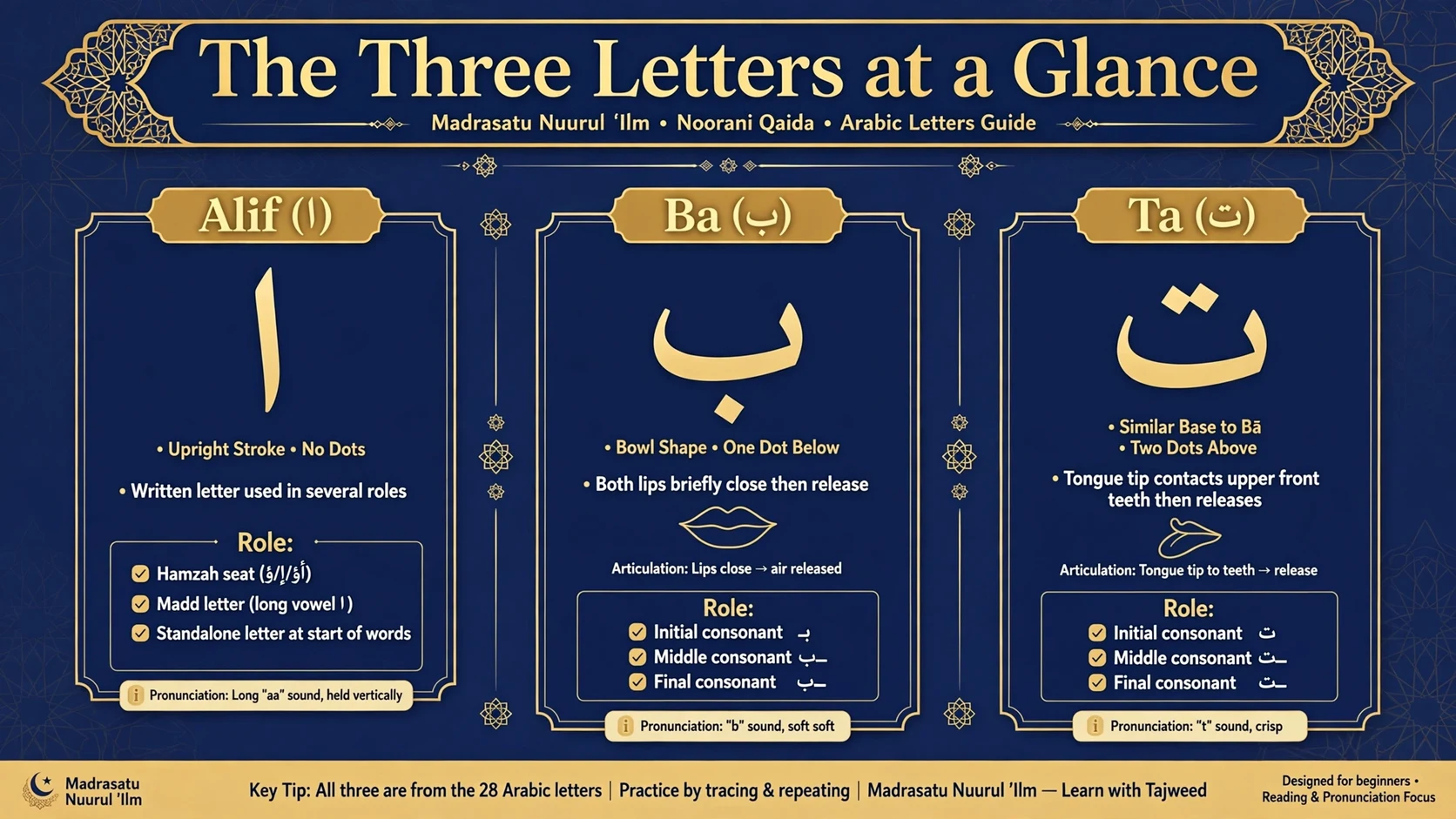
| Letter | Common name | Articulation summary | Beginner recognition clue |
| ا | Alif | Written letter used in several roles; hamza must be distinguished | Upright stroke without dots |
| ب | Ba | Both lips briefly close, then release | Bowl-shaped form with one dot below |
| ت | Ta | Tongue tip/blade contacts the upper dental or alveolar area, then releases | Similar base outline to ba, with two dots above |
This table is a starting guide, not a substitute for an Arabic teacher demonstrating the actual sound. Physical descriptions are especially helpful when the student’s usual language produces a similar but not identical consonant. The teacher listens for accuracy and adjusts the learner’s articulation as needed.
How to Pronounce Ba (ب) Correctly
Ba is a voiced consonant made with the two lips. Bring the lips together gently, build the sound for a brief moment, and release them without exaggeration. In English, the consonant at the beginning of “book” may offer a rough reference, but the complete Arabic sound must be learned with an Arabic model rather than inferred from an English word. Avoid using the English vowel sounds that follow the consonant as part of the letter itself.
In a Qaida lesson, the teacher may show بَ, بِ, and بُ. All three begin with the same consonant, but the vowel changes. The learner should keep the lip closure consistent while changing only the short vowel. The fatha is generally a short /a/-type sound, the kasra a short /i/-type sound, and the damma a short /u/-type sound. These labels approximate the vowel quality; pronunciation should still be checked by listening.
A useful exercise is to hold a small card with ب in front of the learner. Ask them to identify the letter, then listen as the teacher models three differently marked forms. The student repeats each without adding an unnecessary extra syllable. The lips should work naturally, not squeeze or puff dramatically. Clear articulation does not require force.
How to Pronounce Ta (ت) Correctly
Ta is a voiceless stop made with the front of the tongue near the upper front teeth and adjacent gum ridge. It differs from ba because the lips are not the primary closure point. The tongue makes contact, airflow stops briefly, and the consonant is released. Some students may produce a familiar Bengali or English “t” without noticing that its exact position differs from the teacher’s Arabic model. Close listening and adjustment are therefore useful.
The word ta can refer to the letter’s name, but the written forms تَ, تِ, and تُ must be read with the appropriate short vowels. The learner should identify the two dots above the letter before attempting the sound. This connects the visual clue with the correct oral response.
A simple test is to alternate ب and ت while keeping the short vowel the same. The learner must change the articulation from the lips to the tongue, not just change how loudly the syllable is spoken. Practise slowly enough to feel the movement. Then ask the learner to point to the correct printed letter after hearing the teacher’s model. This develops listening and letter recognition together.
Why Alif (ا) Needs a Different Explanation
The sign ا may look like the simplest letter in the alphabet, but its sound is not as simple as its shape suggests.
Many introductory charts label ا as alif and begin the alphabet with it. That is appropriate for recognizing the symbol, but its role in actual words is more complex than a simple consonant with one fixed pronunciation. For example, in an ordinary long-vowel pattern, alif may lengthen a preceding fatha. A written hamza on an alif carrier represents a glottal stop with the relevant vowel. The distinction becomes important as soon as students begin reading short syllables and words.
Compare أ and بَ. The first contains hamza on an alif carrier, while the second has the consonant ba. They are not examples of the same type of consonant. The teacher can explain that plain ا and hamza (ء) are related in writing but have different functions. Beginners do not need every orthographic exception immediately; they do need to avoid believing that a plain alif is always pronounced with an invented vowel.
When teaching the alphabet orally, it is reasonable to introduce “alif” as the letter name. When teaching reading, show the actual vowel-led spelling the learner is expected to say. This two-step distinction respects beginner comprehension while preparing students for accurate Quranic script recognition.
Practise the Three Letters With Short Vowels
| Written example | What changes? | Suggested teacher-led task |
| بَ / بِ / بُ | Only the short vowel changes | Keep the same lip consonant while varying the vowel |
| تَ / تِ / تُ | Only the short vowel changes | Keep the tongue articulation stable while varying the vowel |
| بَ / تَ | Consonant changes; fatha stays | Alternate lip and tongue articulation slowly |
| بِ / تِ | Consonant changes; kasra stays | Point to the correct letter after hearing the teacher |
| أَ / إِ / أُ | Hamza carries different short vowels | Listen for the glottal onset and read the displayed mark |
The chart is designed for guided teaching. Do not ask a beginner to infer the sound solely from the Latin approximation “ba,” “bi,” or “bu.” Those spellings are convenient study labels but may conceal differences between languages. Instead, listen to the teacher, read the actual Arabic symbol, and imitate the specific sound.
A learner who recognizes the marks but struggles orally should not be pushed into long words immediately. Separate the skills. Check the written mark first; then practise the sound. When both become stable, join them again in a short reading exercise. This method often reveals whether the difficulty is visual, auditory, or articulatory.
The Role of Makharij in Alif Ba Ta Lessons
Makharij refers to points of articulation: where speech sounds are produced. The term becomes especially useful when comparing the consonants ba and ta. Ba uses a complete lip closure, while ta depends on the front of the tongue making contact near the upper teeth. Hamza, when present, is a glottal stop, made at the glottis. These distinctions cannot be communicated reliably by asking the student to repeat a Latin spelling louder.
An instructor may invite a learner to watch the teacher’s mouth, feel the movement of their own lips, and compare a spoken example with the printed sign. In a video lesson, a clear camera angle and reliable audio help. If the learner cannot hear subtle differences because of background noise or device problems, the teacher should address the sound quality before judging pronunciation.
Some Arabic sounds require deliberate attention to the throat or back of the tongue. Alif Ba Ta is a suitable place to introduce the general idea of makharij without overwhelming the student with an entire phonetic system. Precise feedback from the beginning makes later lessons less confusing.
A Five-Minute Teacher-Guided Pronunciation Drill
Try this short sequence after a teacher has modeled the sounds accurately:
- Look: Identify ا, ب, and ت in an unfamiliar order without using their position on a memorized chart.
- Listen: Hear a modeled ba or ta consonant and point to the correct character.
- Feel: Notice the lip closure for ب and the tongue contact for ت, without forcing either sound.
- Read: Practise a few forms with fatha, kasra, or damma, keeping the short vowel short.
- Check: Ask the teacher which sound or mark needs revision and repeat only that target.
This drill is intentionally small. Repetition becomes more useful when the learner knows exactly what is being practised. If the student has not yet learned vowel marks, focus on recognition and oral modeling rather than introducing every syllable simultaneously. The exercise can be adapted for a child’s shorter attention span or an adult’s more analytical approach.
Use Listening and Seeing Together
Some learners identify the correct character from a chart but confuse it when they hear it. Others can imitate the sound but cannot locate the symbol. Both are common stages in learning a new writing system. A good lesson connects auditory recognition, visual recognition, and oral production without assuming that progress in one guarantees progress in another.
Start with matching. The teacher pronounces a sound, and the learner selects the letter. Then reverse the task: show the letter, and ask the learner to reproduce the modeled sound. Next, change the letter order. If the learner succeeds only when the letters appear in the familiar alphabet sequence, return to mixed recognition practice. If the learner chooses correctly but articulates incorrectly, focus on mouth position and sound comparison.
Recorded audio can be useful for remembering the teacher’s example between sessions. It cannot determine whether the learner’s own tongue or lips produced the intended sound. Teacher feedback remains especially important for a beginning reader who has not yet developed reliable self-monitoring.
What Children Often Find Difficult
For young learners, the abstract idea of an articulation point can be unfamiliar. Asking a child to understand the words “alveolar ridge” may be less effective than showing where the tongue touches. An instructor can offer simple, accurate descriptions and short demonstrations. The child should not be expected to make exaggerated mouth movements or hold uncomfortable positions.
Visual recognition also matters. Ba and ta share a base shape, so the dots provide an immediate clue. A child can point to one dot below for ب and two dots above for ت, then listen to the associated consonant. This is an ideal example of why sound and letter recognition should be practised together rather than as unrelated exercises.
Children may begin repeating an incorrect sound because it earns approval for being quick. Praise thoughtful attempts and careful correction instead. A slower correct response is a stronger foundation than a fast guess. Parents can reinforce recognition at home while relying on the teacher to verify Arabic articulation.
Pronunciation Advice for Adult Beginners
Adults often try to compare an unfamiliar Arabic sound with the nearest equivalent in their own language. This can be useful as an initial explanation but becomes misleading when the sounds are not identical. An English-speaking student may overuse an aspirated “t,” while a Bengali-speaking student may bring familiar dental or retroflex habits into an Arabic example. Neither learner should be shamed for using their first language as a reference; the instructor should guide them toward the Arabic target.
Adults may benefit from recording a short practice attempt and comparing it with the teacher’s feedback, provided the teacher is comfortable using that method. Listen for the specific feature under study rather than attempting to perfect every part of speech at once. For example, focus on the change from lip closure to tongue closure in one exercise. In another, focus on keeping the short vowel brief.
A common adult frustration is feeling that the first three letters are too basic to justify a full lesson. But careful foundations make advanced reading more efficient. Learning to hear and produce these differences creates habits that can transfer to the rest of the alphabet.
Alif Ba Ta Pronunciation Mistakes to Avoid
The first mistake is treating letter names as though they are the only sounds the letters can make. The second is reading plain alif as an independent consonant with one fixed vowel in every context. The third is confusing ba and ta because their isolated shapes look similar. A fourth is adding extra vowels when practising a consonant, especially after a teacher has specifically asked for a short sound.
Another error is speaking louder instead of changing the articulation. If the problem is that the tongue is in the wrong position, increased volume will not solve it. The teacher should identify the physical difference and ask for a calmer, more accurate attempt. Students should also avoid assuming that transliteration gives an exact phonetic record. English and Bengali letters are approximations, not a replacement for hearing Arabic.
How to Correct a Repeated Pronunciation Error
Correction works best when the teacher identifies a single contrast. If ba is inaccurate, check whether the lips close completely. If ta is inaccurate, listen and observe the position of the tongue and the release. If the learner has confused alif and hamza, return to a written example that clearly shows which character is functioning as a consonant. Do not correct five unrelated details at the same time.
Next, use a progression: one modeled sound, one repeated sound, one differently marked example, and one new recognition task. The teacher can then ask the student to read the item again without prompting. This verifies whether the correction has transferred into actual reading rather than being a one-time imitation.
Students need permission to make careful attempts. Avoid turning correction into a contest or emphasizing mistakes as personal shortcomings. A clear, consistent feedback routine makes it easier to identify a specific difficulty and return to it at the next lesson.
Teaching Alif Ba Ta in Online Quran Classes
Live online instruction allows a teacher to model the letter and listen to the student’s attempt. A shared lesson page can show the Arabic script clearly, while voice and video help demonstrate lip and tongue movement. The quality of sound matters; unstable audio can conceal distinctions that are important in pronunciation lessons.
For parents, the strongest sign of useful instruction is not simply that a child repeats “alif ba ta” during a call. It is that the teacher checks which symbol the child is seeing, asks for an independent response, and provides specific feedback. A class should gradually move toward recognition of unfamiliar examples and appropriate reading with short vowels.
Madrasatu Nuurul ‘Ilm provides beginner online Quran education with Bengali-language instruction. Students can explore its Basic Online Noorani Qaida Course to see how alphabet and pronunciation lessons connect with the larger reading curriculum.
When Is a Student Ready for More Letters?
A learner is ready for the next stage when they can recognize Alif, Ba, and Ta in different positions, distinguish the dots, and read the marked examples without guessing. The student should also be able to connect the spoken consonant with the printed symbol. If the student still relies on the sequence to find each letter, the teacher should continue with mixed recognition tasks before adding new symbols.
Reading words should come only after individual letters and short syllables feel familiar. Move forward when a student can read بَ, بِ, بُ, تَ, تِ, تُ and identify the relevant vowel mark confidently. Pushing ahead too quickly may leave the student uncertain about the first letters and make later lessons harder than they need to be.
Choosing Between Alphabet Practice and Tajweed Study
A student who cannot identify basic letters should normally focus on foundational recognition and articulation before attempting a detailed Tajweed curriculum. Conversely, a learner who recognizes Arabic text accurately but repeatedly mispronounces certain consonants may benefit from focused pronunciation and Tajweed instruction. The correct choice depends on an assessment of present ability.
Families considering more advanced recitation work can review the academy’s Quran Learning With Tajweed Course after the basics are established. There is no value in rushing into terminology if the learner still needs help distinguishing ba from ta in a new printed example.
Practice Materials: What Helps and What Does Not
A clear letter chart and a small group of flashcards can be useful for recognition. A teacher-provided audio example may help with review. A large screen or printed handout makes it easier to notice dots and vowel marks. These tools become more effective when each practice task has one purpose: identify a letter, hear a consonant, or read a marked syllable.
What does not work well is using only a phonetic English or Bengali transcription and never looking at the Arabic letter. Another weak strategy is relying on generic audio without feedback and assuming repetition guarantees accuracy. An app may mark a tapping exercise correct because the learner selected the right symbol; it cannot necessarily verify the quality of a spoken Arabic articulation.
The materials should support teacher-guided learning, not replace the teacher’s role. Beginners may be unaware that their production is different from the model. Listening and individual correction bridge that gap.
Frequently Asked Questions About Alif Ba Ta Pronunciation
Is the sound of alif always “aa”?
No. Alif has different orthographic roles, and a plain alif should not be treated as an independent consonant that always says one vowel. In the appropriate context it can represent a long /ā/ sound. Hamza has its own consonantal sound and may be written on an alif carrier. A teacher should explain the relevant example on the page.
How do you pronounce ba in Arabic?
The consonant ب is produced by briefly bringing both lips together and releasing them with voicing. When it carries a short vowel mark, the vowel determines the rest of the syllable. Correct Arabic pronunciation is best learned from a teacher’s model rather than an English approximation alone.
Where does the tongue go for ta?
For ت, the front of the tongue contacts the area around the upper front teeth and nearby gum ridge, then releases. It is a voiceless stop. A teacher can demonstrate the exact placement and correct differences caused by a learner’s native-language habits.
Are ba and ta pronounced the same way?
No. Both are stops, but ب is voiced and uses the lips, while ت is voiceless and uses the front of the tongue. The letters also have different dot patterns in the Arabic script. Learners should distinguish both the written symbols and their sounds.
Does Noorani Qaida teach correct Alif Ba Ta pronunciation?
It introduces the letters and provides a structured setting for learning their sounds. Actual pronunciation quality depends on teaching, listening, and correction. A printed primer alone cannot detect whether a beginner has articulated a consonant accurately.
The student should be able to recognize each letter and produce its intended sound without confusing the letters, and to identify the sound from a printed example. Short daily practice with a teacher is generally more useful than an occasional long session.
Can children learn Alif Ba Ta online?
Yes. Children can learn through clear shared materials, short practice tasks, and live teacher feedback. Parents may help manage the device and practice routine. The teacher should model sounds and check the child’s own attempts rather than relying only on memorized recitation.
Should I use Bengali or English phonetics?
Phonetic spellings can be temporary explanations, but they cannot fully represent every Arabic sound. Students should look at Arabic script and listen to a reliable Arabic model. The teacher can explain concepts in Bengali or English without replacing the original pronunciation.
What is the difference between Alif Ba Ta and a full Arabic alphabet lesson?
Alif Ba Ta is an introductory focus on the opening letters and their sound distinctions. A complete alphabet lesson covers the full set of Arabic letters, visual families, and additional articulation challenges. Connected words and short vowels then develop the broader reading skills.
How can I tell if my pronunciation is correct?
Ask a qualified teacher to listen to unfamiliar examples and identify specific articulation errors. Self-recording may be helpful for reviewing feedback, but learners should not rely entirely on their own judgment when learning sounds they cannot yet distinguish reliably.
What should I learn after Alif Ba Ta?
Continue with the remaining Arabic letters, their shapes, and correct makharij. As recognition develops, practise the short vowel marks, joined-letter forms, and beginner reading exercises. The sequence should reflect your current rather than a rigid completion promise.
Start Correct Arabic Pronunciation With Madrasatu Nuurul ‘Ilm
Good pronunciation is built by hearing, observing, and correcting the same simple sound many times. The method used here applies throughout Quran reading: identify the actual symbol, listen to the intended Arabic sound, and practise with informed correction. The three letters are simple to recognise, but they open the door to important distinctions between names, consonants, vowels, and written signs.
Madrasatu Nuurul ‘Ilm offers live online Quran classes with Bengali-language teaching support for beginners, children, and adults. Families can book a free trial class to discuss their current pronunciation needs and learn how teacher-guided lessons work. To plan a suitable schedule, review the current pricing and class options before enrollment.
Contact Madrasatu Nuurul ‘Ilm
Phone / WhatsApp: 01834-756502
Email: madrasatunurulilm912@gmail.com
Website: https://madrasatunurulilm.com/
Service: Online Arabic letter pronunciation, Noorani Qaida, and Quran education for beginners.
Next step: Ask about a free trial and a teacher-led pronunciation assessment.