
Similar Sounding Arabic Letters: How to Hear and Pronounce Them


Similar sounding Arabic letters are consonants that beginners may confuse because their sounds appear close in English or Bengali, even though Arabic distinguishes them. Common examples include س and ص, ح and ه, ك and ق, and ت and ط. The most dependable way to tell them apart is to learn their articulation points (makharij), notice their sound qualities (sifaat), listen to accurate models, and practise contrasting examples with a teacher who can correct mistakes.
A learner may recognize every letter on a Noorani Qaida chart yet repeatedly substitute one consonant for another when reading aloud. That does not automatically mean they are careless. Different languages divide the sound system in different ways. Someone who grew up speaking Bengali or English may not initially perceive a distinction that is meaningful in Arabic. This guide focuses on those contrasts rather than repeating the entire alphabet lesson. It explains what to listen for, how mouth position changes, and why careful correction matters when reading Quranic Arabic.
Why Do Different Arabic Letters Sound Alike to Beginners?
Human speech perception is influenced by the languages people already know. If two Arabic sounds map to one familiar category in a student’s first language, the learner may hear them as equivalent. Transliteration can deepen the problem. English often represents multiple Arabic sounds with the same plain Latin letters, especially “h,” “s,” “t,” and “z.” Bengali transliteration has comparable limitations.
The first reason is that sounds that are distinct in Arabic may not be contrastive in the learner’s native language. For example, a Bengali speaker may need a clear auditory demonstration that ص is an emphatic form of /s/ rather than just a louder “s.” Similarly, a speaker who does not use a pharyngeal fricative in daily speech may require an explicit model for ح. Learners need to hear, and later imitate, the specific qualities that mark a sound as Arabic.
An efficient way to begin is to compare the sounds in pairs. Listening carefully to two similar sounds is easier than trying to absorb a whole table of unfamiliar contrasts at once. Identify the main point where each sound is produced and practise each articulation separately before combining them into meaningful reading. This is more systematic than assuming that saying the alphabet from memory will automatically produce accurate pronunciation.
A Comparison Chart of Commonly Confused Arabic Letters
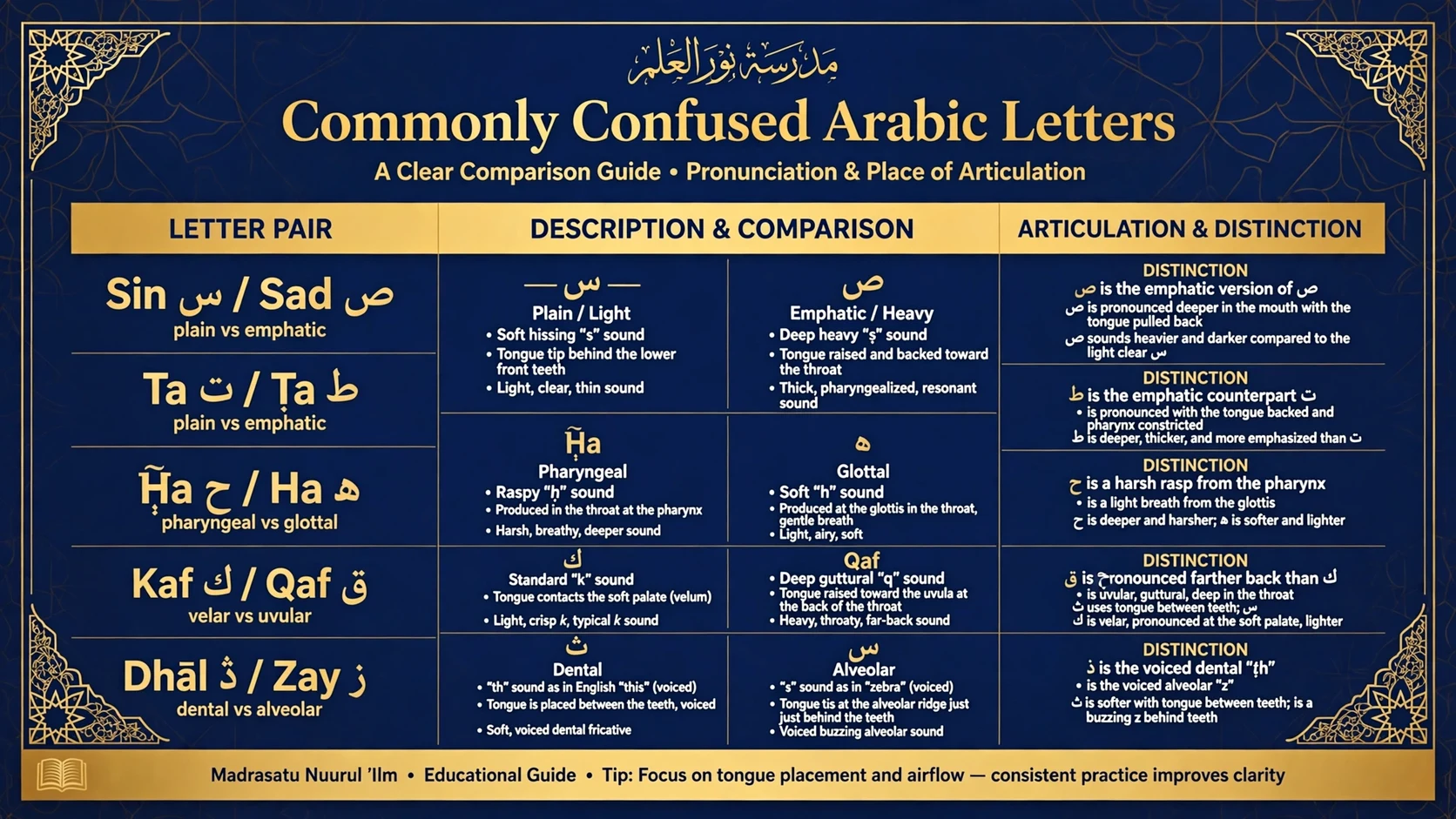
| Letter contrast | What often causes confusion | Main distinction to learn |
| س / ص | Both are often transliterated with an “s” | ص has emphatic, backed resonance; س is plain |
| ت / ط | Both may be called “t” | ط has emphatic articulation; ت is plain |
| ح / ه | Both are often represented as “h” | ح is pharyngeal; ه is glottal |
| ك / ق | Both may be heard as “k” | ك is velar; ق is produced farther back, typically uvular |
| ث / س | A beginner may replace both with “s” | ث is a dental fricative; س is alveolar |
| ذ / ز | English-style “z” may replace both | ذ is dental; ز is alveolar |
| خ / غ | Both are made in the back region of the vocal tract | خ is voiceless; غ is voiced |
| ء / ع | Both can be misunderstood as unfamiliar throat sounds | ء is a glottal stop; ع is a voiced pharyngeal sound |
| ض / د | Both may be simplified into one “d” | ض has a distinctive emphatic articulation that is not ordinary د |
These descriptions are simplified for beginners. Exact phonetic realizations may vary by accepted recitation tradition and scholarly articulation terminology. The teacher’s authentic recitation model remains essential. A table helps identify which difference to listen for, but it cannot by itself teach the exact movement of the tongue or throat.
Sin (س) Versus Sad (ص): Plain and Emphatic Sounds
This is one of the most frequently discussed contrasts in beginner Tajweed instruction. Both letters are sibilants, so the learner hears an “s”-like noise. However, س is a plain consonant, while ص is emphatic, with a backed or pharyngealized quality. Its resonance influences the neighboring vowel sound as well. Simply shouting the sibilant more loudly does not create the correct ص.
A teacher can help the learner compare the two while keeping the vowel and overall speaking effort similar. The goal is to notice the difference in resonance and tongue configuration, not to exaggerate volume. Listen to a correct model, repeat a short syllable, and ask for feedback. Some students can identify the sounds by ear before reproducing them accurately. That is useful progress; hearing and production are related but distinct abilities.
English and Bengali transliteration often use the same letter or a similar spelling for both, which explains why written approximations are unreliable. If the learner always reads a Romanized “s,” the original Arabic distinction is hidden. Practice should center on the Arabic letters themselves and an accurate audio model.
Ta (ت) Versus Ta (ط): A Change in Resonance
The letters ت and ط may be introduced using the same approximate “t” in English teaching materials, although their Arabic qualities differ. ت is a plain voiceless stop articulated near the upper front teeth and adjacent ridge. ط is emphatic and has a more backed resonance. The learner needs to change the sound’s quality, not turn the second letter into a louder version of the first.
A practical exercise uses two short teacher-modeled examples with matching vowels. After listening, the learner identifies whether the plain or emphatic consonant was spoken. The teacher can then ask the learner to produce the contrast and correct the tongue position or resonance as needed. It is important not to introduce an extra vowel after the consonant when practising it as sakin.
Some Bengali speakers have familiar dental and retroflex stop contrasts, but those are not automatically identical to Arabic ت and ط. Using a native-language comparison can start a conversation, yet the Arabic model must determine the target. A teacher should explain where the comparison helps and where it becomes misleading.
Ha (ح) Versus Ha (ه): Two Distinct Throat Sounds
Both ح and ه are commonly written as “h” in casual English transliteration. Yet they are not the same Arabic sound. ح is a voiceless pharyngeal fricative produced with a constriction in the throat, whereas ه is a voiceless glottal fricative. The difference is difficult to communicate through a Latin spelling because many languages do not distinguish these two categories.
Students should learn to hear the two sounds in careful, natural recitation. Trying to imitate ح by coughing or making an exaggerated rasp can strain the throat and distort the target. A qualified teacher models the sound calmly and adjusts the learner’s effort. The throat should not be forced into an uncomfortable position. A clean, controlled attempt is better than an aggressive noise.
A learner may find that ه feels familiar but ح requires a new listening category. Short, repeated contrasts are often more useful than long explanations about throat anatomy. The teacher can gradually introduce vowelled examples so the learner recognizes the consonant in connected speech.
Kaf (ك) Versus Qaf (ق): Front and Back Articulation
The difference between ك and ق is a common challenge because both are stops produced toward the rear of the oral cavity. ك is generally velar, while ق is typically uvular in Classical Arabic and Quranic recitation. The latter is articulated farther back than ك. Learners who produce both like an ordinary English “k” may lose this distinction.
It is tempting to describe ق as a “harder k,” but hardness does not tell the learner precisely where to articulate it. A better explanation focuses on the tongue’s contact location. The teacher can model the difference slowly, help the learner listen, and correct the placement. The learner should not force the throat or make the sound unnecessarily harsh.
The distinction matters both in isolated letter practice and in real words. Reading slowly with accurate consonant identification is more important than achieving an impressive recitation speed. Once the learner recognizes the pair reliably, the teacher can introduce it in short vowelled combinations.
Tha (ث) Versus Sin (س): Dental and Alveolar Fricatives
Some beginners replace ث with س because both can be perceived as a light hiss. However, ث is a voiceless dental fricative, produced with the tongue near the upper front teeth, while س is a voiceless alveolar sibilant. English speakers may recognize a rough similarity between ث and the “th” in “think,” although that reference is not a complete pronunciation lesson.
Bengali speakers may have different habits because ordinary Bengali pronunciation does not necessarily maintain the same English dental fricative contrast. An instructor can demonstrate the tongue’s placement and the nature of the airflow. Learners should avoid biting the tongue or overextending it. The goal is a controlled fricative produced at the appropriate place.
Practice is more meaningful when the two letters carry the same short vowel. Then the learner can concentrate on the consonant difference. Once that becomes reliable, the same pair can be practised inside words or short reading sequences assigned by the teacher.
Dhal (ذ) Versus Zay (ز): A Familiar Transliteration Trap
ذ and ز can both be written as “z” in informal Romanization, but ذ is a voiced dental fricative, while ز is a voiced alveolar fricative. Some students replace ذ with ز because the latter resembles a sound they already know. Others confuse ذ with a familiar “d”-like consonant. Learning the actual articulation helps the student avoid relying on oversimplified Latin spelling.
A teacher can model ذ with the tongue near the upper teeth and compare it with ز. Both are voiced, so the key distinction is not simply whether the throat vibrates. The placement and airflow differ. Students can practise first by identifying which letter was spoken, then by producing each sound in a short syllable. Their attempts should be corrected in real time rather than scored only by a mobile recording.
The printed Arabic characters are also visually distinct, so this pair provides a useful test of whether the learner’s difficulty is hearing, reading, or pronunciation. Someone who picks the right letter but says the wrong sound needs a different exercise from someone who cannot distinguish the symbols on the page.
Kha (خ) Versus Ghayn (غ): Similar Location, Different Voicing
خ and غ share a broad back-of-the-vocal-tract region, making them another useful comparison. خ is typically a voiceless fricative, while غ is voiced. A learner might hear both as rough throat sounds and use the same articulation for each. Instructors should focus on the difference in voicing without encouraging excessive force.
One approach is to have the teacher alternate the two sounds clearly. The student listens for the presence of voicing, then attempts the contrast. Vowels can be added after the learner is comfortable with the basic sound. If the exercise causes throat discomfort, the learner should stop and seek guidance rather than repeatedly pushing harder.
A scientifically accurate description is helpful, but Quran reading is a practical skill. The learner needs to hear and reproduce a correct model, not memorize anatomical terminology for an exam. The teacher can adjust the explanation to the learner’s age and familiarity with speech sounds.
Hamza (ء) Versus Ayn (ع): Two Sounds Often Flattened by Transliteration
Hamza is a glottal stop, while ع is a voiced pharyngeal consonant. Both can be difficult for beginners whose first language does not distinguish them in the same way. Informal transliteration sometimes uses apostrophes or omits symbols entirely, which can make the difference nearly invisible on the page. For this reason, learners should use Arabic script and teacher modeling rather than relying exclusively on Romanized syllables.
The teacher should introduce the sounds carefully and avoid forcing the learner to produce an unfamiliar throat constriction immediately. A student may need to hear multiple examples before reliably identifying the contrast. When the listening distinction improves, oral imitation becomes easier to target. Written examples can then show how the two letters appear in different contexts.
The educational priority is accurate articulation at a comfortable effort. Overexaggerated throat movements are not a reliable shortcut to Quranic pronunciation. The gradual method used for other pairs—listen, identify, attempt, correct—works here as well.
Why Dad (ض) Is Not Just an Ordinary Dal (د)
The Arabic letter ض is often described as distinctive in traditional Arabic pronunciation instruction. For beginners, the essential point is that it is not interchangeable with د. The emphatic nature and articulation of ض differ from the plain consonant د. Regional accents and transliteration systems may obscure the difference, so learners should rely on a qualified Quran recitation teacher.
This pair should not be taught through a crude instruction such as “say d louder.” A louder ordinary consonant remains the wrong sound. Instead, the teacher should demonstrate the correct Arabic articulation and compare it with د in a controlled exercise. Students may need more time for this distinction than for a visually obvious pair. Careful correction prevents an inaccurate habit from becoming automatic.
The same principle applies to other emphatic consonants. Their defining quality is not simply force or intensity, and a simplistic English transcription may hide a distinction that Arabic preserves. Listening to a consistent model is therefore essential.
Similar Sounds Versus Similar-Looking Letters
Some Arabic letters confuse beginners because they sound alike to an untrained ear. Others are confusing mainly because they look alike on the page. These are different challenges and require different exercises. The pair س / ص is fundamentally a sound contrast, while ب / ت / ث is often initially a dot-recognition problem as well as a pronunciation task.
If a student cannot identify which character appears in the printed text, use recognition exercises before demanding an oral contrast. If the student recognizes the correct letter but substitutes its sound, focus on listening and articulation. If both skills are unstable, work in small alternating steps. This distinction saves lesson time because the teacher addresses the real source of the error.
Reading progress improves when instructors separate visual identification from auditory discrimination. A child can point to the correct symbol while still pronouncing it incorrectly; an adult may hear the right sound but choose the wrong written character. Both learners need feedback that matches the precise difficulty.
How to Practise Arabic Sound Pairs Safely and Effectively
Use a teacher-modeled contrast routine rather than guessing from transliteration:
- Choose one pair: Practise two consonants such as س and ص instead of reviewing every difficult Arabic sound at once.
- Listen without reading: Ask the learner to identify which of the two sounds the teacher has modeled, using several examples in varied order.
- Watch and feel: Discuss the relevant mouth or throat position without forcing exaggerated movements.
- Read with a matching vowel: Keep the vowel consistent so attention stays on the consonant contrast.
- Transfer to a new example: Read a previously unseen combination and ask the teacher to identify any remaining substitution.
A few accurate repetitions can be more useful than a long series of unchecked attempts. When a learner repeatedly produces the wrong sound, pause and return to a clear model. The objective is not to train endurance but to develop a stable contrast. A teacher can decide when to advance from isolated syllables into longer words.
A Pair-by-Pair Practice Plan
| Practice session | Letter pair | Listening task | Reading task |
| 1 | س / ص | Identify plain versus emphatic sibilant | Read short vowelled contrasts |
| 2 | ت / ط | Identify plain versus emphatic stop | Read teacher-selected syllables |
| 3 | ح / ه | Distinguish the two throat sounds | Read short examples with feedback |
| 4 | ك / ق | Hear velar versus farther-back stop | Practise printed contrasts slowly |
| 5 | ث / س and ذ / ز | Identify dental versus alveolar sounds | Read simple mixed examples |
| 6 | Mixed review | Identify all previously studied contrasts | Attempt short unfamiliar practice lines |
This is a flexible practice outline, not a guarantee that six sessions will be sufficient. A learner may need several meetings for one pair. Others may already distinguish most sounds and require focused practice on only two or three contrasts. The teacher should choose examples appropriate to the student’s actual stage of Quran reading.
How Bengali-Speaking Learners Can Avoid Sound Substitution
Bengali-speaking students often benefit from explanations in their home language, especially when learning terms such as makhraj and sifaat. Yet Bengali descriptions should support Arabic pronunciation rather than replace it. Several Arabic consonants do not have an exact everyday Bengali equivalent. If a learner always reads from Bengali transliteration, distinct Arabic sounds may be represented by similar-looking Bengali characters.
A better practice method begins with the Arabic letter, a clear teacher model, and a brief explanation of the relevant articulation. The learner then attempts the sound while looking at the Arabic script. Bengali may be used to clarify where the tongue should move or why a contrast matters, but the final response should be an Arabic sound guided by Arabic examples.
Expatriate families sometimes use English at school and Bengali at home. In that setting, one child may encounter multiple spellings for the same Arabic sound. Teachers can reduce confusion by consistently using the original Arabic script as the reference point and treating Romanization as a temporary aid.
What Online Teachers Should Correct First
A teacher may hear several errors in a short reading passage. Correcting every tiny detail simultaneously can overwhelm the learner. A more productive approach is to identify the substitution that most seriously affects letter identity and practise it in isolation before returning to the passage. The teacher can record the specific target for later revision.
For example, if a student reads ق like ك throughout a lesson, the instructor may model the two consonants, listen to the learner’s attempts, and ask for a short contrast reading. If the student can produce the pair in isolation but loses it in connected speech, the next exercise should use short words or syllable sequences. This moves from controlled practice toward normal reading.
Feedback should distinguish recognition errors from articulation errors. Saying only “read again” may not help a learner who cannot hear what was wrong. A precise explanation, a suitable model, and a manageable retry give the student something actionable.
How Noorani Qaida Supports Pronunciation Accuracy
Noorani Qaida introduces the Arabic script and basic pronunciation in a structured setting. For students who cannot yet recognize the letters reliably, it offers a foundation before longer Quran reading. However, no printed primer can by itself tell whether the learner pronounced ح or ه accurately. That requires listening, correction, and repeated practice with a suitable teacher.
Madrasatu Nuurul ‘Ilm offers live online beginner learning through its Basic Online Noorani Qaida Course. Students can discuss difficult pairs with an instructor while working on letter recognition, short vowels, and early reading. The goal is not merely to recognize a symbol, but to learn how to pronounce it as part of Arabic recitation.
Learners who already read connected Quranic text may need deeper work on makharij and sifaat. For that purpose, the academy also offers a Quran Learning With Tajweed Course. A teacher-led assessment can help determine whether a learner should focus on basic Qaida practice or more advanced recitation correction.
Frequently Asked Questions About Similar Sounding Arabic Letters
Which Arabic letters sound most similar to beginners?
Commonly confused pairs include ح / ه, س / ص, ت / ط, ك / ق, ث / س, and ذ / ز. The exact difficult pairs vary depending on the learner’s home language and previous Arabic exposure.
Is the difference between س and ص just volume?
No. The distinction involves emphatic articulation and resonance, not simply loudness. Producing ص by shouting س does not create the correct Arabic consonant. Teacher modeling and careful comparison are more reliable than volume-based instructions.
Why are ح and ه difficult for English speakers?
English does not distinguish these two Arabic throat consonants as separate phonemes. Both may be represented as “h” in casual transliteration. The learner needs to hear and practise the different articulation points with a knowledgeable teacher.
Is ق just a harder version of ك?
No. The consonants differ in articulation location: ك is velar, while ق is generally produced farther back, typically uvular, in Classical Arabic recitation. Calling ق merely a harder ك can be misleading because greater force does not automatically change the articulation correctly.
Are heavy and light Arabic letters the same as loud and quiet letters?
No. Heavy and light describe phonetic qualities related to resonance and articulation, not speaker volume. Raising the voice is not an accurate way to produce an emphatic consonant. Teachers should demonstrate the relevant distinction through controlled examples.
Can transliteration teach these differences?
It can help label letters, but it often hides distinctions because one Latin symbol may represent several Arabic sounds. Students should use the original Arabic letters and listen to accurate pronunciation models rather than relying only on English or Bengali approximations.
Can children practise similar Arabic sounds online?
Yes. Short live exercises with clear audio allow an instructor to model contrasting sounds and hear the child’s attempts. The teacher should adjust the pace, correct specific errors, and make the practice manageable. A recording alone cannot offer the same individualized feedback.
Should beginners learn every pair at once?
Usually not. Concentrating on one difficult pair at a time helps the learner notice what differs. Once a contrast is stable, the teacher can mix it with previously learned sounds and eventually use it in short reading passages.
What if I recognize the right letter but say the wrong sound?
That suggests the visual recognition skill is ahead of the pronunciation skill. Continue teacher-guided listening and articulation exercises for that pair. If you cannot choose the correct printed letter either, add recognition practice as a separate task.
Is Noorani Qaida enough to master all Arabic pronunciation?
Noorani Qaida provides foundational reading and introduces important pronunciation distinctions, but accurate and consistent Quran recitation may require continued Tajweed study and supervised reading. A teacher can assess which sounds still need correction after the beginner primer.
Improve Your Arabic Letter Pronunciation With Guided Learning
Learning to distinguish similar sounding Arabic letters requires more than memorizing a list of pairs. The learner must recognize the correct symbol, hear the intended sound, understand its articulation, and practise it until the distinction carries over into reading. With patient correction, students can replace uncertain approximations with more reliable Quranic Arabic pronunciation.
Madrasatu Nuurul ‘Ilm supports beginners and more experienced Quran learners through online classes and Bengali-language guidance. If you are unsure which sounds are causing difficulty, you can request a free trial class and ask for a pronunciation assessment. Families can also consult the academy’s current class pricing when choosing a suitable schedule.
Contact Madrasatu Nuurul ‘Ilm
Phone / WhatsApp: 01834-756502
Email: madrasatunurulilm912@gmail.com
Website: https://madrasatunurulilm.com/
Service: Online Noorani Qaida, Arabic pronunciation, and Tajweed instruction for children and adults.
Next step: Ask about a free trial class and individualized pronunciation feedback.